
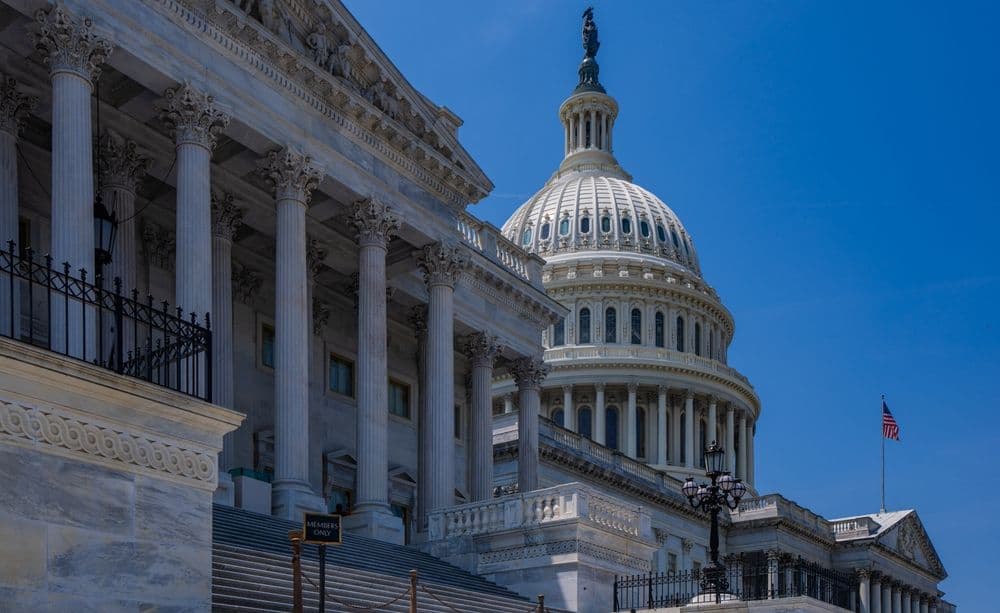
 Lawmakers in the U.S. Senate are considering a housing bill that includes a provision blocking the Federal Reserve from launching a digital dollar until the end of the decade. (Shutterstock)
White House quickly issuing a statement saying they SUPPORT the 21st Century ROAD to Housing Act, touting the ban on institutional investors as well as a prohibition on a central bank digital currency until the end of 2030. https://t.co/UnmkwHjjFT pic.twitter.com/a0AmaF0of5
— Brendan Pedersen (@BrendanPedersen) March 2, 2026
Although the legislation focuses overwhelmingly on housing policy, from expanding affordable housing programs to reforming development incentives, it also includes a separate section that would prohibit the Federal Reserve or any Federal Reserve bank from issuing a CBDC either directly or through financial intermediaries.
The clause states that the Federal Reserve Board of Governors or Federal Reserve Banks may not “issue or create” a central bank digital currency, or a substantially similar digital asset, either directly or indirectly through financial institutions.
Under the proposal, the restriction would remain in place until December 31, 2030, after which Congress would need to revisit the issue if lawmakers wish to extend or formalize the prohibition.
The ROAD to Housing Act spans hundreds of pages and addresses a wide range of housing-related issues, including efforts to streamline home construction, modernize financing mechanisms, and expand housing inventory across the country.
Lawmakers introduced the measure with the stated aim of tackling the persistent shortage of affordable housing in the United States, an issue that has intensified in recent years as supply constraints and rising borrowing costs have pushed homeownership further out of reach for many families.
The digital currency provision, however, represents a distinct policy direction unrelated to housing supply itself. The clause appears to have emerged from broader negotiations among lawmakers seeking ways to address digital asset policy through larger legislative packages rather than pursuing standalone crypto bills.
The result is an unusual pairing: a housing reform package that also functions as one of the most consequential legislative signals yet on the future of a potential U.S. digital dollar.
Central bank digital currencies have become a prominent subject of debate globally as governments explore the possibility of issuing state-backed digital versions of national currencies.
In the United States, however, policymakers remain divided over whether such a system would improve payment infrastructure or introduce new risks.
Critics of a digital dollar frequently raise concerns about privacy, financial surveillance, and the potential for government overreach in the payments system. Some lawmakers have also warned that a widely accessible CBDC could disrupt the banking sector by allowing individuals to hold digital dollars directly with the central bank.
Supporters of the technology argue that a well-designed CBDC could modernize payment rails, improve cross-border settlement, and maintain the global relevance of the U.S. dollar in a financial system increasingly shaped by digital assets.
The Federal Reserve itself has taken a cautious approach. Officials have repeatedly emphasized that the central bank would not launch a digital dollar without explicit authorization from Congress, describing current research efforts as exploratory rather than a commitment to deployment.
Importantly, the language in the housing bill does not permanently block a U.S. CBDC.
Instead, it introduces a temporary legislative cap, preventing the Federal Reserve from issuing a digital dollar until the end of 2030.
That sunset clause suggests lawmakers may view the provision as a pause rather than a definitive rejection of CBDC technology. By establishing a time-bound restriction, Congress effectively postpones the question while the global financial system continues experimenting with digital currency models.
Across the world, dozens of countries are exploring CBDC frameworks, with some, including The Bahamas, Jamaica and Nigeria, already launching operational digital currencies.
Other major economies, such as the European Union and China, remain in advanced testing phases.
Against that backdrop, the U.S. debate continues to reflect a broader tension between technological innovation and institutional caution.
Before becoming law, the housing bill must still move through several legislative stages.
Although the Senate has advanced the legislation with strong bipartisan support, including a procedural vote passing 84–6, the measure will still need to be reconciled with the House of Representatives before reaching the president’s desk.
During that process, lawmakers could potentially revise or remove individual provisions, including the digital currency clause.

AI reshapes institutional learning across MENA

New FinTech Pilots Take Shape in Dubai

Firebird scales up Armenia’s AI infrastructure

AI-generated viruses raise new biosafety questions

Stay ahead with the latest updates, insights, and trends shaping the world of finance, investment, blockchain, digital business, fintech, technology, and global markets.

