

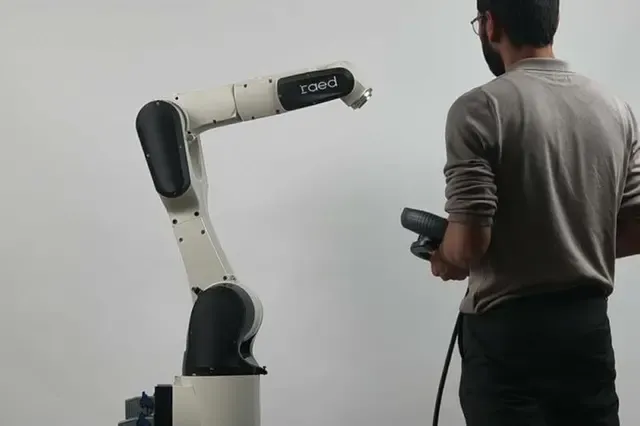
 Raedbots officially launched in Egypt, positioning itself as the first homegrown industrial robotics manufacturer in the Middle East. (Image source: Zawya)
A Cairo-based startup, Raedbots, has officially launched as what is being described as the first company in Egypt and the wider Middle East focused on the local design and manufacturing of industrial robots. The announcement positions the company as part of a broader push toward localized industrial technology development.
Raedbots aims to address a growing demand for automation across the region by offering robotics systems that are both more affordable and tailored to local manufacturing environments.
At the core of Raedbots’ strategy is vertical integration. Rather than assembling or reselling imported components, the company says it develops its entire technology stack internally, including mechanical systems, electronics, control software, and artificial intelligence capabilities.
This approach is intended to reduce reliance on foreign suppliers while lowering the cost barrier for manufacturers that have historically struggled to justify the high upfront investment associated with industrial automation.
Mohamed Ibrahim, Chief Technology Officer (CTO) of Raedbots, said that the company is redefining automation: "We aren't just building industrial robots; we are providing integrated robotic solutions that help facilities and factories optimize productivity, reduce costs, and enhance safety standards." He added that locally designed robotic arms significantly lower the initial investment barrier, enabling manufacturers to adopt automation more rapidly while maintaining high levels of precision and reliability.
That distinction matters. In many factories, robotics adoption is not just about installing machines, but about integrating them into workflows that often vary significantly across regions and industries.
One of the more notable claims in the announcement is cost reduction. Raedbots says its locally developed systems can cut automation costs by as much as 50% compared to imported alternatives.
For smaller and mid-sized manufacturers, particularly in emerging markets, that difference could be decisive. High costs have long been cited as one of the main barriers preventing wider adoption of robotics across MENA.
By designing products specifically for regional needs, the company is betting that it can offer both affordability and practical usability, rather than forcing manufacturers to adapt to systems built for entirely different industrial contexts.
Raedbots is positioning its products as “smart industrial robots” powered by what it refers to as physical AI, combining hardware systems with intelligent software capable of perception, motion planning, and task execution.
The company’s initial applications include welding, CNC machine tending, material handling and packaging, and warehouse automation. These are core functions across manufacturing and logistics, making them a logical entry point for a new robotics provider.
Despite its local manufacturing focus, Raedbots is not operating in isolation. The company has joined the NVIDIA Inception program, which supports startups developing advanced AI technologies. Through this partnership, Raedbots gains access to simulation tools and computing infrastructure that can accelerate development and testing.
At the same time, the startup is supported domestically through Egypt’s Technology Innovation and Entrepreneurship Center (TIEC), part of the Ministry of Communications and Information Technology. The initiative is designed to foster innovation and strengthen the country’s technology ecosystem.
This combination of local institutional backing and international technical support reflects a hybrid model increasingly seen in emerging tech ecosystems.
The emergence of a local robotics manufacturer highlights a broader trend: a growing emphasis on reducing dependence on imported industrial technologies.
Historically, robotics systems in MENA have been sourced from established global players, often at significant cost and with limited customization for local conditions.
By contrast, companies like Raedbots are attempting to build solutions from the ground up, tailored to regional manufacturing realities. If successful, this approach could expand access to automation for a wider range of businesses, particularly those previously priced out of the market.
The company is already working with factories, industrial partners, and research institutions to deploy its systems, while continuing to expand its product portfolio and manufacturing capacity.
Raedbots remains an early-stage entrant in a highly competitive global industry. Established robotics manufacturers bring decades of experience, extensive product lines, and proven reliability at scale.
The real test will be whether local manufacturers are willing to shift from trusted international suppliers to a new, regionally built alternative.
Still, the company’s launch signals something larger than a single startup story. It reflects a growing ambition within Egypt and the wider region to move beyond being consumers of advanced technologies and toward becoming producers.
Gulf firms target digital finance infrastructure

From science Olympiad to Silicon Valley

Dubai approval brings Revolut closer

Nasdaq Dubai welcomes Ajman Bank’s $300 million Sukuk

Stay ahead with the latest updates, insights, and trends shaping the world of finance, investment, blockchain, digital business, fintech, technology, and global markets.
