

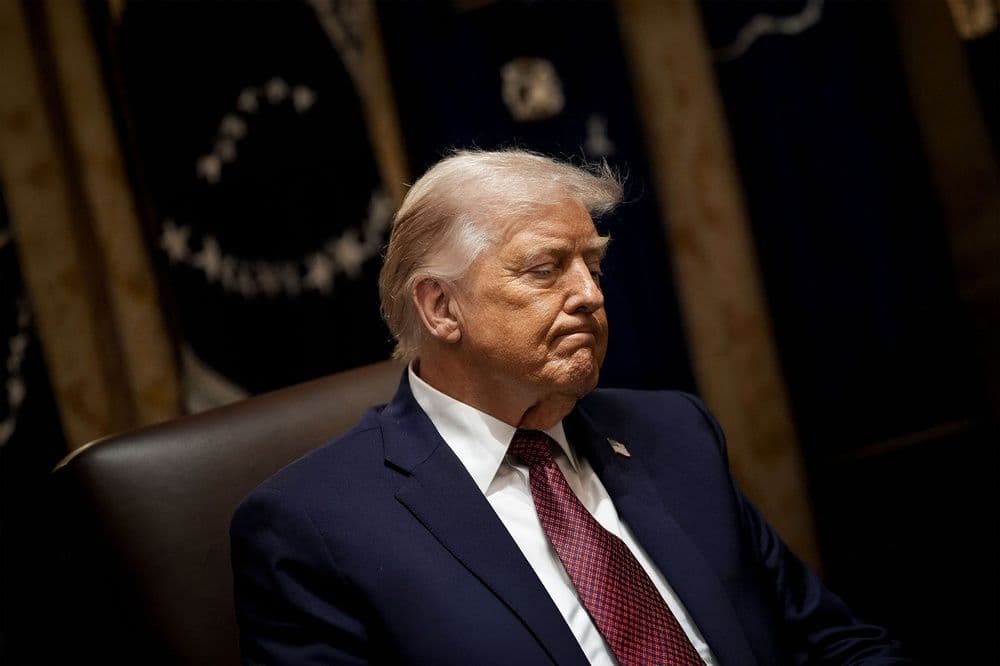
 Donald J. Trump moves to lift the baseline U.S. tariff rate to 15% after a high court decision. (Shutterstock)
In a post published on Truth Social, Trump wrote that after “a thorough, detailed, and complete review” of the Court’s decision, he would increase the “10% Worldwide Tariff on Countries” to what he described as the “fully allowed, and legally tested, 15% level.” He added that over the coming months, his administration will determine and issue additional tariffs it considers legally permissible.
The president’s statement, posted on his verified Truth Social account, did not specify which Supreme Court ruling he was referencing, nor did it outline the statutory authority under which the tariff increase would be implemented.
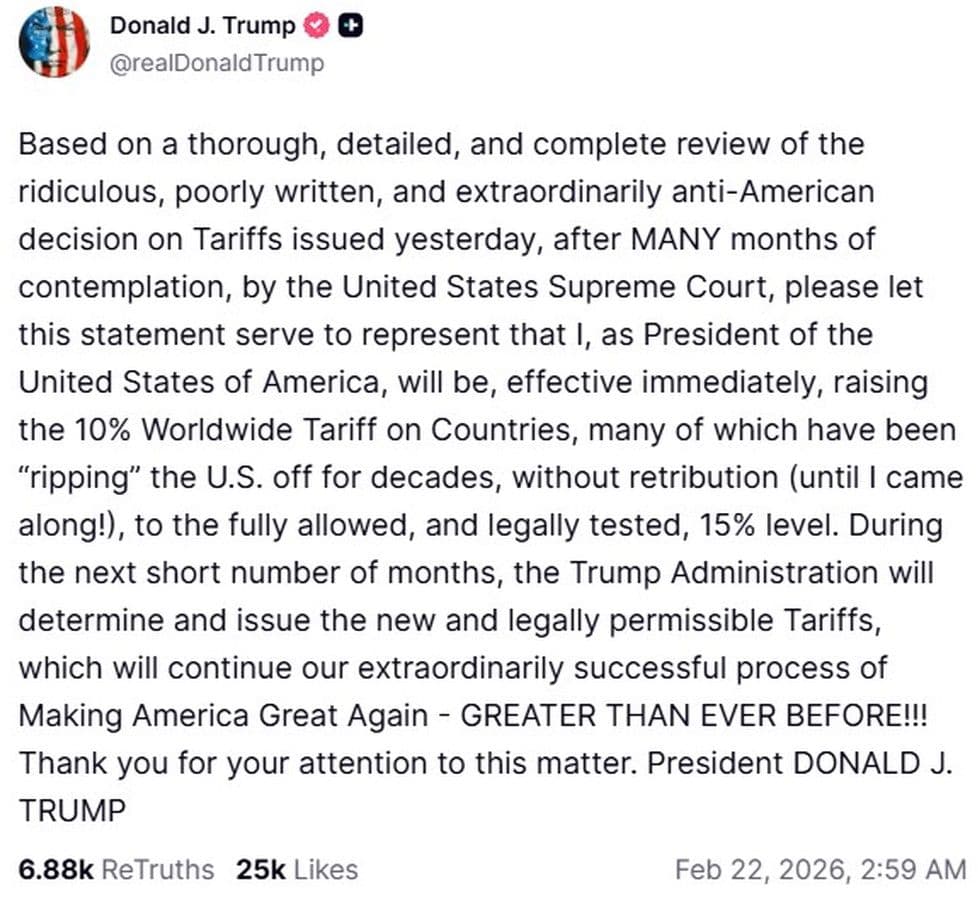 Source: Donald J. Trump
Tariffs in the United States are rooted in congressional authority under Article I of the Constitution, which grants Congress the power to regulate commerce with foreign nations. Over time, lawmakers have delegated portions of that authority to the executive branch through legislation such as the Trade Expansion Act of 1962 and the Trade Act of 1974. These statutes allow a president to impose or adjust tariffs under defined circumstances, including national security concerns or findings of unfair trade practices.
During his first term in office, Trump relied on Section 232 of the Trade Expansion Act to impose tariffs on steel and aluminum imports, arguing that foreign dependence threatened U.S. national security. He also invoked Section 301 of the Trade Act of 1974 to levy duties on a broad range of Chinese goods following an investigation by the Office of the United States Trade Representative into alleged unfair trade practices. Those actions triggered legal challenges in U.S. courts and disputes at the World Trade Organization.
The new proposal signals a broader approach. A universal baseline tariff applied across multiple countries would represent a significant shift in U.S. trade posture. Trade policy specialists note that such a measure would likely face close legal examination, particularly if it bypasses investigative procedures or public comment requirements that typically accompany tariff actions.
In his post, Trump framed the move as corrective, arguing that many countries have been “ripping” the United States off for decades. He characterized the tariff increase as part of what he called the administration’s “extraordinarily successful process” of strengthening the U.S. economy.
Financial markets have historically responded swiftly to tariff announcements. During earlier trade tensions between the United States and China, equity markets experienced volatility, and companies with global supply chains reported higher costs tied to import duties. Economists often caution that tariffs can function as a tax on imported goods, potentially raising input costs for businesses and consumer prices domestically. Supporters of protective trade measures, however, argue that tariffs can incentivize domestic manufacturing and provide leverage in international negotiations.
International reaction may prove decisive. Key U.S. trading partners, including the European Union, Canada, Mexico and China previously responded to U.S. tariffs with retaliatory measures of their own. The World Trade Organization, though currently constrained by challenges to its appellate body, remains a forum where member states can contest trade actions.
At present, Trump’s announcement functions as a policy declaration rather than a finalized regulatory change. Implementation would require formal action by the executive branch, likely accompanied by documentation specifying the legal authority invoked and the timeline for enforcement. Importers, manufacturers, and retailers would require clarity on effective dates to adjust contracts, pricing strategies, and supply chain planning.
Whether the proposed 15% rate materializes as formal policy will depend on how the administration structures the measure and the legal authority it invokes. With trade already a central theme of Trump’s economic agenda, the announcement signals that tariffs remain a core tool in the White House’s approach to global commerce and that further developments could follow in the months ahead.

Cobi looks to scale enterprise AI

Abu Dhabi opens door to Coinbase tokenization

AI reshapes institutional learning across MENA

Traditional assets gain a bigger blockchain footprint

Stay ahead with the latest updates, insights, and trends shaping the world of finance, investment, blockchain, digital business, fintech, technology, and global markets.
