

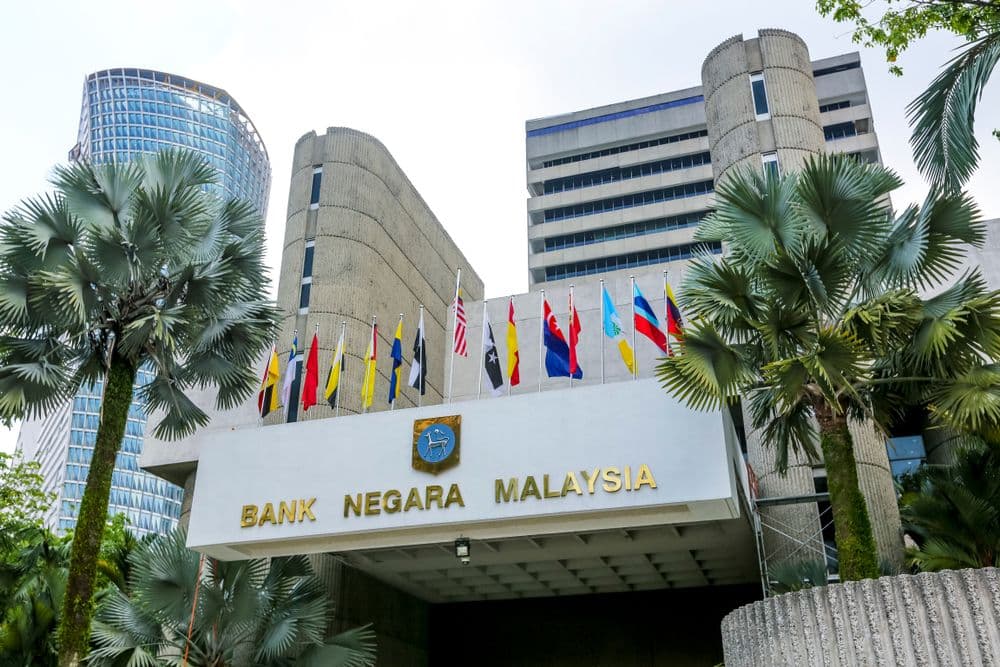
 Bank Negara Malaysia, which is conducting controlled trials involving ringgit stablecoins and tokenized deposits. (Shutterstock)
Bank Negara Malaysia (BNM) has begun testing ringgit-denominated stablecoins and tokenized deposits through its Digital Asset Innovation Hub (DAIH), signaling a deeper regulatory engagement with blockchain-based financial infrastructure.
The initiative establishes a controlled regulatory environment that allows financial institutions to experiment with digital representations of money under central bank supervision. Instead of accelerating toward immediate commercial deployment, BNM is using these pilots to gather data and evaluate potential impacts on financial stability, monetary policy, and operational resilience. Findings from the trials are expected to inform a broader regulatory framework anticipated by the end of 2026.
Three pilot initiatives are currently underway. One involves exploring the issuance and settlement of a ringgit-pegged stablecoin in a wholesale environment. That test is being conducted by Standard Chartered Bank Malaysia in collaboration with Capital A, the aviation and digital services group. In parallel, Malayan Banking Bhd (Maybank) and CIMB Group Holdings Bhd (CIMB) are running separate experiments involving tokenized deposits to assess whether digitally represented bank deposits can streamline domestic and cross-border payment flows.
The distinction between stablecoins and tokenized deposits is subtle but important. Stablecoins are typically digital tokens backed by fiat reserves and designed to maintain parity with a national currency. Tokenized deposits, by contrast, represent existing commercial bank deposits on a distributed ledger. While both instruments can enable programmable settlement, their regulatory treatment and systemic implications differ. BNM’s decision to test both suggests the central bank is evaluating multiple architectures rather than committing to a single model prematurely.
Malaysia’s approach reflects its long-standing effort to modernize financial infrastructure without compromising prudential oversight. The pilots are being conducted in a closed environment with participation from regulated financial institutions and selected corporate clients. In certain cases, considerations related to Islamic finance compliance are also being examined, consistent with Malaysia’s position as a global hub for Shariah-compliant financial services.
While performance data from the pilots has not been released, Bank Negara Malaysia has made clear the testing is designed to help it assess practical considerations such as operational effectiveness and systemic implications before deciding on broader adoption. The central bank’s published discussions on digital currencies and related settlement systems underscore a methodical approach to innovation, prioritizing careful evaluation and risk assessment over hasty deployment.
The broader significance of these trials lies in wholesale markets rather than retail payments. Wholesale settlement systems underpin interbank transfers, securities transactions, and high-value corporate flows. Improvements in these systems can have cascading effects across the financial ecosystem. By focusing on wholesale use cases, BNM is targeting areas where efficiency gains could be meaningful while minimizing consumer-level risk exposure during the experimental phase.
 Hong Kong is gearing up to roll out a stablecoin licensing regime in 2026, marking a significant step toward clearer and more structured oversight of digital assets. (Shutterstock)
Malaysia is not alone in pursuing this path. Across Asia, regulators are exploring tokenized money frameworks under varying models. Hong Kong is preparing to implement a stablecoin licensing regime in 2026, reflecting a broader regional shift toward formal oversight of digital asset issuance. Within that context, Malaysia’s Digital Asset Innovation Hub positions the country within the same regulatory conversation, albeit with a distinctly measured and pilot-driven approach.
Since its establishment in 2025, the Digital Asset Innovation Hub has attracted participation from a range of domestic and international institutions, signaling clear market interest in regulated experimentation. The breadth of engagement suggests that banks and corporate entities increasingly view tokenized money not as a passing trend, but as a potential structural evolution in financial infrastructure.
Policymakers face complex questions. Can tokenized instruments deliver measurable efficiency improvements over existing real-time gross settlement systems? Will stablecoin structures introduce new liquidity or redemption risks? How should prudential safeguards be calibrated if programmable money becomes integrated into wholesale banking operations? These are not theoretical concerns; they strike at the core of monetary sovereignty and systemic stability.
BNM has made clear that it is not committing to full-scale issuance or regulatory approval at this stage. Instead, it is prioritizing empirical data from controlled trials. That approach reflects lessons learned globally over the past several years, as both private stablecoin issuers and public institutions have grappled with volatility events, regulatory uncertainty, and evolving technology standards. Malaysia’s financial sector is entering a transitional moment. The country has already built strong foundations in digital payments and Islamic fintech. By examining ringgit-linked stablecoins and tokenized deposits within a supervised framework, the central bank is signaling that digital value infrastructure is shifting from peripheral innovation toward core financial architecture.
These pilots may eventually shape formal regulatory frameworks, wholesale digital currency issuance, or broader commercial deployment, but that direction will hinge on findings that have yet to be made public. What is already evident is Malaysia’s deliberate, evidence-driven approach, placing regulatory oversight alongside technological experimentation rather than trailing behind it.
The Digital Asset Innovation Hub could offer a practical blueprint for how mid-sized economies bring blockchain-based settlement tools into established financial systems without unsettling them. The ringgit’s digital future is still being tested behind the scenes, but the momentum toward deeper integration is becoming harder to ignore.

Dubai approval brings Revolut closer

UAE visitors gain easier banking access

Partior powers faster cross-border settlements

Business payments get a digital overhaul

Stay ahead with the latest updates, insights, and trends shaping the world of finance, investment, blockchain, digital business, fintech, technology, and global markets.
