

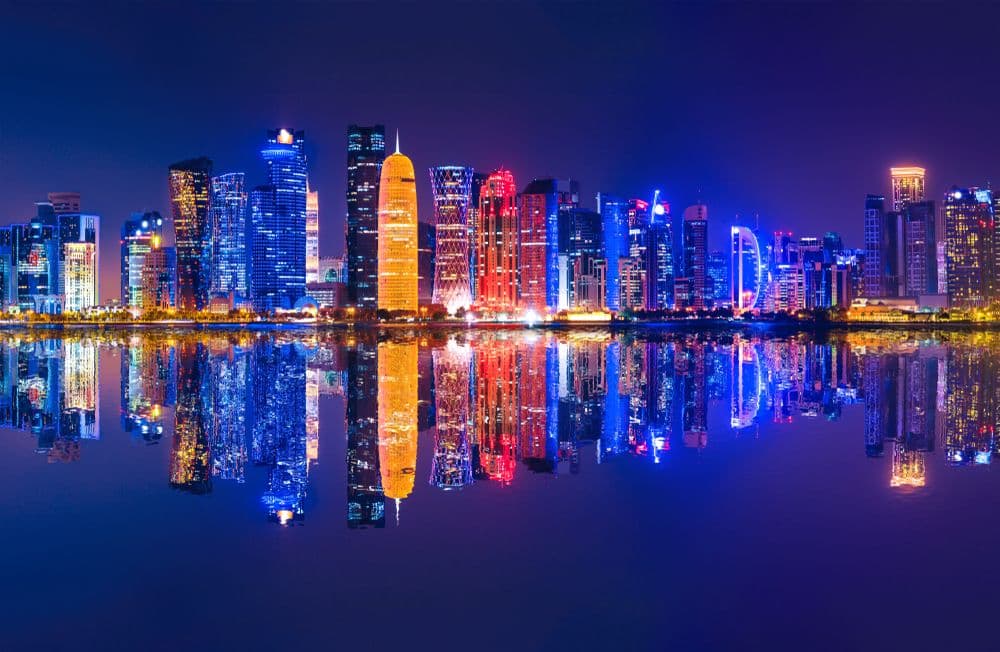
 Qatar’s latest FDI figures highlight growing cross-border capital flows into the Gulf state. (Shutterstock)
According to the NPC, inward FDI positions in Qatar increased by 7% compared with the previous quarter, bringing total inward FDI stock to approximately $43.1 billion by the end of Q3 2025 (around QAR 157 billion). At the same time, outward FDI positions rose by about 3%, reaching roughly $55.8 billion (approximately QAR 203 billion). Together, the numbers reflect not only capital flows but investor sentiment toward Qatar’s economic environment during a period of global uncertainty.
The 7% quarterly rise in inward FDI comes at a time when global investment patterns remain cautious. Across several emerging and advanced markets, investors are navigating inflation pressures, higher borrowing costs, and geopolitical tensions. Against that backdrop, the steady increase in foreign capital positions in Qatar suggests that international investors continue to view the country as a stable and attractive destination for long-term deployment of funds.
The composition of inward investment provides additional insight. According to the NPC’s breakdown, more than 95% of inward FDI is concentrated in five key sectors. Mining and quarrying account for 44% of inward positions, underscoring the continued importance of hydrocarbons and energy-related activities in the Qatari economy. Financial and insurance activities represent 32%, indicating strong foreign participation in the country’s financial services ecosystem. Manufacturing captures 15%, reflecting investment in industrial capacity and downstream activities. Professional, scientific, and technical activities account for 5%, while public administration represents 2%.
While mining remains the single largest recipient of foreign capital, the sizable allocation to financial and insurance activities signals broader economic diversification. Financial services, in particular, often serve as a multiplier sector, supporting corporate activity, infrastructure development, and cross-border transactions. The presence of professional and technical services in the investment mix further suggests that knowledge-based and specialized industries are gradually expanding their footprint.
Outbound investment patterns also reveal how Qatari capital is engaging internationally. The NPC reports that outward FDI positions reached approximately $55.8 billion by the end of Q3 2025 (around QAR 203 billion), reflecting a 3% quarterly increase. Financial and insurance activities account for 33% of outward positions, while mining and quarrying represent 27%. Information and communication activities comprise 12%, transportation and storage make up 11%, and arts, entertainment, and recreation represent 7%. These figures, as cited in the NPC release, illustrate the diversification of Qatari investments abroad across both traditional and emerging sectors.
The prominence of financial services in outward investment aligns with Qatar’s broader strategy of maintaining an active presence in global capital markets. Meanwhile, allocations to information and communication, transportation, and even creative sectors highlight a willingness among Qatari investors to pursue opportunities beyond core energy assets. Such diversification mirrors broader trends across the Gulf Cooperation Council, where both sovereign and private capital are increasingly seeking growth across multiple industries and regions.
Policymakers view the quarterly FDI survey as a critical barometer of economic performance and investor confidence. Growth in inward FDI is often interpreted as a sign that regulatory frameworks, market access conditions, and macroeconomic stability are aligned with investor expectations. Meanwhile, expansion in outward FDI can indicate capital strength and deeper integration into global markets.
The Q3 2025 figures arrive within the broader context of Qatar National Vision 2030, the country’s long-term development framework aimed at economic diversification and sustainable growth. The data aligns with ongoing efforts to strengthen non-energy sectors and deepen international economic linkages. Any detailed reference to Qatar National Vision 2030 would require citation of official government policy documents.
AI joins Dubai’s park planning

Hscale enters Dubai Holding’s radar

UAE wealthtech courts boutique managers
UAE looks beyond borders on AI

Stay ahead with the latest updates, insights, and trends shaping the world of finance, investment, blockchain, digital business, fintech, technology, and global markets.
