
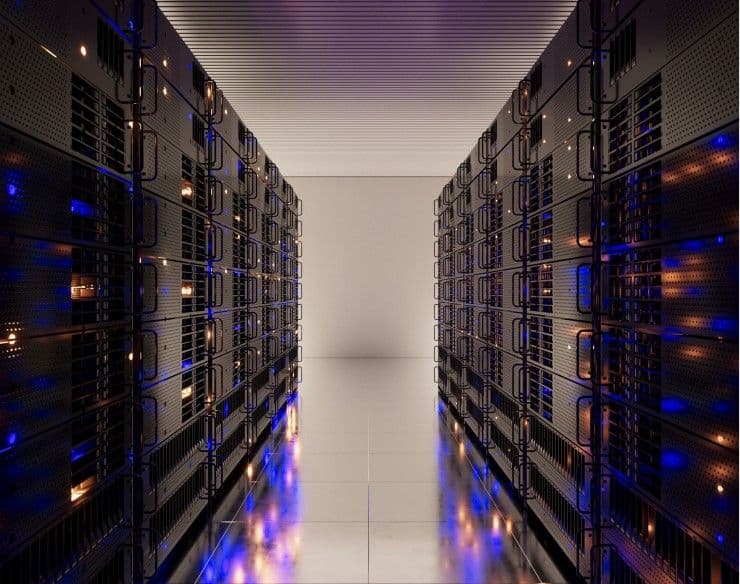
 Dubai DAMAC founder nears $20B AI goal after securing U.S. power capacity. (Unsplash/Modified by Block News International)
The company has secured around $12 billion worth of land and electrical power capacity for AI-focused data centers, putting it more than halfway toward its previously announced $20 billion investment target, according to a report by Tribe Techie.
The move stands out as one of the most significant cross-border investments into U.S. digital infrastructure in recent years. Best known for its luxury real estate projects, Damac has been steadily reshaping its business under chairman and CEO Hussain Sajwani, shifting capital and expertise toward power-hungry digital assets that sit at the heart of AI development, cloud computing, and next-generation data processing.
Sajwani has said the secured portfolio includes sites in Ohio and New Jersey, with further evaluations underway in Texas. The state has increasingly attracted large-scale data center projects, driven by its relatively strong grid capacity and business-friendly environment.
Sajwani indicated at the World Economic Forum in Davos that the company has secured around 1 gigawatt of land capacity, translating into an estimated $12 billion in total investment. He added that reaching the full $20 billion commitment is likely to take between two and four years, depending on execution timelines and market conditions.
Power availability sits at the center of that strategy. AI workloads, particularly those used to train large language models and advanced systems, demand vast amounts of electricity. As a result, many large AI data centers are now designed to operate at hundreds of megawatts, with some pushing beyond one gigawatt of electrical demand, according to industry estimates.
Damac’s data center expansion is being led through its subsidiary, Edgnex Data Centers by Damac, which has been extending the group’s reach well beyond traditional property development. The company has already announced AI-focused data center projects in Asia, including a facility in Indonesia valued at more than $2.3 billion, but the U.S. initiative represents its most capital-intensive push so far.
Plans for the U.S. expansion first came into public view in early 2025, when Sajwani and President Donald Trump highlighted Damac’s intention to invest $20 billion in data centers across multiple American states, including Texas and Ohio.
The timing of Damac’s move aligns with a broader shift in how data infrastructure is viewed across the United States. As artificial intelligence becomes a strategic priority, large-scale data centers are increasingly seen as critical national assets. At the same time, rising demand from AI, cloud computing and crypto mining is placing growing pressure on electricity grids and regulatory frameworks.
Utility operators and grid planners are now wrestling with how to accommodate these massive new power loads without triggering bottlenecks that could affect pricing or reliability. In several major power markets, the volume of proposed data center projects moving through planning and interconnection processes is accelerating, adding new layers of complexity to long-term grid planning.
AI-oriented data centers often operate at power levels comparable to those of entire cities. That reality is forcing utilities and policymakers to rethink how capacity is built, how transmission networks are expanded, and how regional electricity markets are structured.
Damac’s expansion reflects a wider trend in which sovereign capital and global investors are treating digital infrastructure as a long-term strategic asset, sitting at the intersection of technology, energy, and industrial policy. Coming from a company with deep roots in luxury real estate, the shift underscores just how powerfully the AI boom is reshaping investment priorities across sectors.

Partior powers faster cross-border settlements

Business payments get a digital overhaul
Abu Dhabi backs round-the-clock clean power
e& closes a major investment chapter

Stay ahead with the latest updates, insights, and trends shaping the world of finance, investment, blockchain, digital business, fintech, technology, and global markets.

