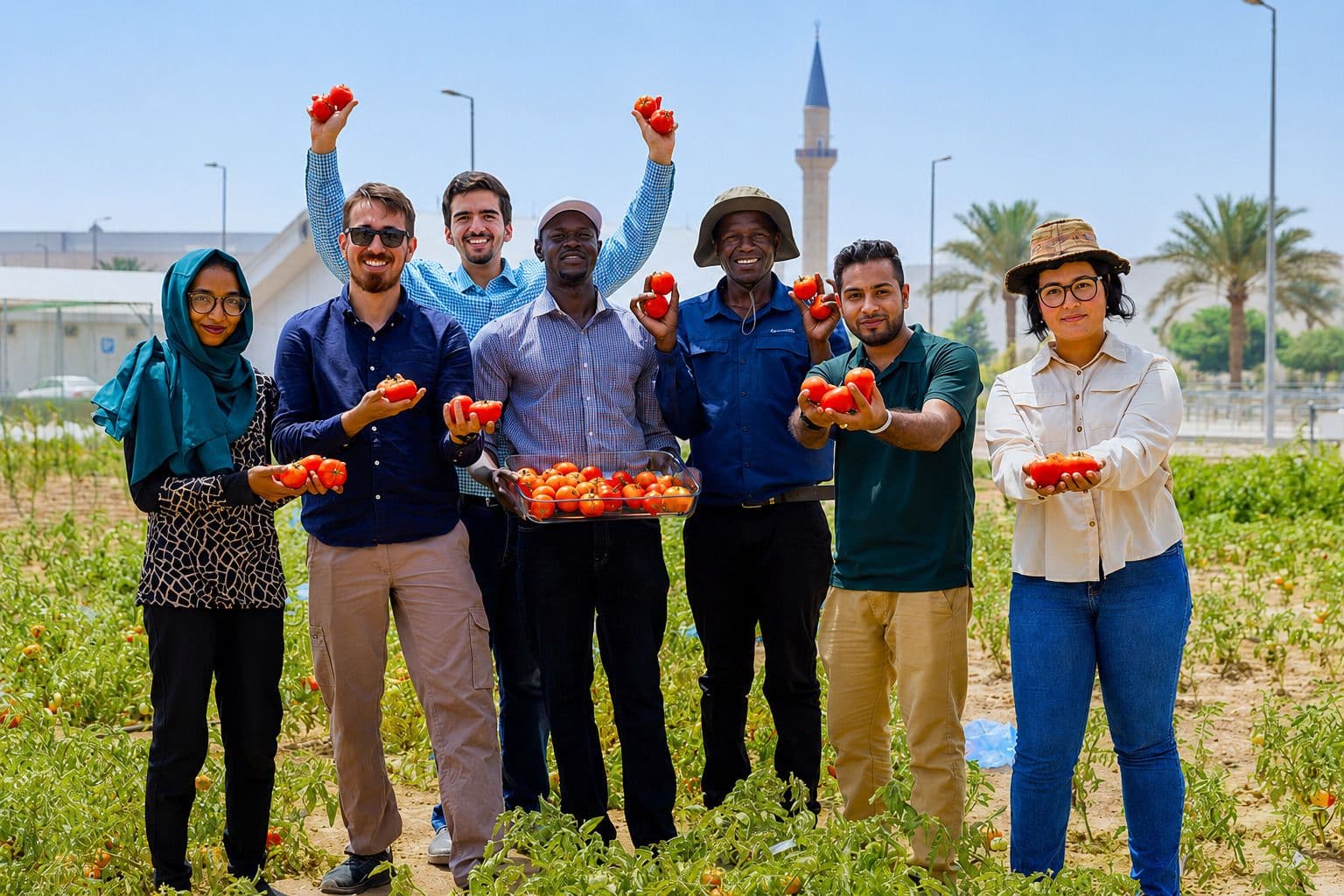
Saudi deep-tech startup Terraxy has secured $3 million (SAR 11.25 million) in Seed-2 funding to expand its desert soil-regeneration technology, strengthening Saudi Arabia’s push to turn laboratory-born climate solutions into commercial infrastructure.
The round was led by Wa’ed Ventures, Aramco’s venture capital fund, with participation from King Abdullah University of Science and Technology. Terraxy was spun out of KAUST research and is focused on improving the performance of sandy soils, a persistent challenge for agriculture, landscaping and land rehabilitation across arid regions.
The company plans to use the capital to move from pilot-scale output to industrial production and wider deployment in Saudi Arabia. A central part of that plan is a 30,000-square-meter commercial facility in Al Zulfi, a city in central Saudi Arabia.
The Growth Challenge Beneath Saudi Sand
Saudi Arabia’s climate ambitions are often associated with renewable energy, hydrogen and carbon management, but soil quality is becoming an increasingly important part of the country’s environmental and food-security agenda. Sandy soils generally struggle to hold water and nutrients, making large-scale planting expensive and resource-intensive.
Terraxy’s flagship product, Carbosoil, is designed to address that problem by improving the ability of sandy soil to retain nutrients and support plant growth. The company describes Carbosoil as a modified biochar product developed through years of KAUST research. KAUST said the product can deliver up to a 70% improvement in plant growth and yield while using the same water and nutrient inputs.
That claim is significant in a country trying to scale greening projects without placing unsustainable pressure on water resources. The Saudi Green Initiative includes a target to grow 10 billion trees across the Kingdom, a goal tied to rehabilitating tens of millions of hectares of land and increasing vegetation cover in one of the world’s most water-stressed environments.
From KAUST Research to Commercial Scale
The funding also highlights the role Saudi universities are playing in the commercialization of deep-tech research. Terraxy’s technology originated at KAUST, where researchers have worked on nature-inspired approaches to improving plant growth in desert conditions.
KAUST said Terraxy has already validated its technology through pilot production and industry collaborations. The Seed-2 round is intended to support a shift from demonstration to commercial supply, a stage where many research-based climate technologies face their most difficult test: proving they can be produced, delivered and used at scale outside controlled research settings.
Wa’ed Ventures’ involvement gives the startup a strategic investor with a mandate to support technology-based companies in Saudi Arabia. Aramco describes Wa’ed Ventures as its venture capital fund for investing in local tech-based startups and localizing global innovations in the Kingdom.
From Regulatory Sandbox to Field Testing
Terraxy’s development has also passed through Saudi Arabia’s regulatory innovation system. KAUST said the company progressed through the Ministry of Environment, Water and Agriculture’s Regulatory Sandbox, which allows emerging environmental technologies to be tested and assessed under real-world conditions.
The MEWA Regulatory Sandbox is designed to help bridge the gap between regulators and innovators in the environment, water and agriculture sectors. That kind of regulatory pathway is especially important for soil and carbon-related products, where performance, safety and environmental claims need to be assessed before broad deployment.
By linking investment, university research and regulatory testing, Terraxy’s case fits a wider Saudi effort to build local technology companies around sustainability challenges that are directly relevant to the Kingdom’s geography.
A Carbon Capture Angle for Terraxy
Beyond plant growth and land rehabilitation, Terraxy is positioning its technology within the carbon-management market. KAUST said Carbosoil can contribute to carbon capture and store carbon dioxide durably for centuries, placing the startup at the intersection of soil regeneration and carbon removal.
That dual-purpose positioning may help the company attract attention from investors looking beyond conventional agtech. Carbon removal remains a developing market, and claims around durability, measurement and verification are increasingly scrutinized. Terraxy’s next phase will likely depend not only on production capacity, but also on how consistently its technology performs in field conditions and how its carbon-storage claims are measured.
The global need is clear. The Food and Agriculture Organization of the United Nations estimates that nearly one-third of the world’s soils are degraded, threatening food security and ecosystem resilience. In arid regions, where water scarcity compounds soil limitations, technologies that improve nutrient retention and plant survival can carry both commercial and environmental value.
A Market Test for KAUST-Born Innovation
The Terraxy round is modest in size compared with headline-making artificial intelligence or energy deals, but it could prove meaningful for Saudi Arabia’s deep-tech ecosystem. The funding targets a localized problem with global relevance: how to restore degraded land and support vegetation in harsh climates.
The company’s Al Zulfi facility will be an important test of whether a KAUST-born soil technology can move from research validation into industrial production. Success would give Terraxy a stronger platform to serve landscaping, agriculture, land rehabilitation and carbon-management customers across Saudi Arabia, and potentially other desert and semi-arid markets.
Saudi Arabia’s sustainability strategy is gaining momentum through companies that can turn scientific research into practical climate solutions. Terraxy’s new funding points to growing investor confidence in the connection between research, regulation and commercial climate infrastructure.