

 From splitting bills to paying businesses, Aani is becoming part of daily financial life across the UAE. (Arry Hashemi/Block News International)
The growth underscores how quickly digital payment infrastructure is being embedded into daily life across the Emirates, as both consumers and businesses shift away from traditional banking channels toward real-time financial services.
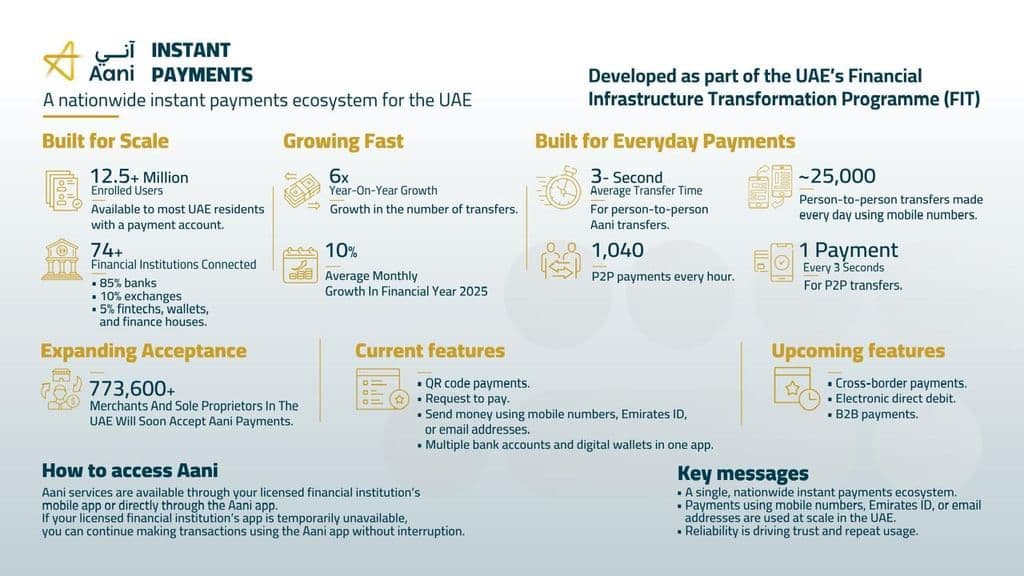
For many users in the UAE, Aani is no longer an abstract fintech initiative. It is increasingly becoming part of routine financial behavior. The platform now processes around 25,000 person-to-person transfers daily, often completed within seconds.
That kind of speed matters in a region where convenience often drives adoption. Sending money using just a mobile number, email, or Emirates ID has reduced friction in everyday transactions, particularly for small payments and informal transfers.
Behind the scenes, the platform is supported by a network of 74 licensed financial institutions. This includes 85% of banks operating in the UAE, alongside exchange houses, digital wallets, and finance companies.
The scale of that integration is what allows Aani to function less like a standalone app and more like a national financial layer connecting multiple institutions.
The user milestone is only one part of the story. Transaction activity on Aani has grown even faster.
 (Image source: WAM)
The platform recorded a sixfold year-on-year increase in transfer volumes, alongside an average monthly growth rate of around 10% throughout 2025.
That kind of sustained growth suggests more than just early adoption. It points to a structural shift in how payments are made in the UAE, particularly as instant, account-to-account transfers begin to compete with cards and cash.
Saif Humaid Al Dhaheri, Assistant Governor for Banking Operations and Support Services at the CBUAE and Chairman of Al Etihad Payments, said: “The rapid growth in Aani’s usage rates reflects customers’ growing confidence in the security and efficiency of our national payment ecosystem, and further reinforces its position as one of the UAE’s leading national payment solutions."
His comments reflect a broader theme in the UAE’s financial strategy: building confidence in domestic infrastructure rather than relying solely on global payment networks.
While early adoption has been driven largely by individuals, Aani is increasingly gaining traction among businesses.
Approximately 774,000 merchants across the UAE are expected to accept Aani payments, signaling growing use in commercial settings.
Businesses benefit from a straightforward value proposition. Instant settlement improves cash flow, reduces reliance on intermediaries, and simplifies reconciliation. In a region with a high volume of small and medium-sized enterprises, these efficiencies can have a measurable impact.
The platform’s ability to process transactions in roughly three seconds also positions it competitively against traditional payment rails, particularly in time-sensitive transactions.
Aani currently supports a range of services, including QR code payments, request-to-pay functionality, and transfers using mobile numbers or identity credentials.
Users can also link multiple bank accounts and wallets within a single interface, a feature that reflects the platform’s ambition to act as a unified payments hub rather than a single-service tool.
Additional capabilities are already in development. These include cross-border payments, electronic direct debit, e-cheques, and business-to-business payment solutions.
If implemented successfully, these features could extend Aani’s role beyond domestic transfers and into broader financial infrastructure.
The rise of Aani is part of a wider effort by the UAE to modernize its financial ecosystem and reduce dependence on cash.
Instant payment systems have become a global trend, but the UAE’s approach stands out for its centralized coordination through the central bank and its rapid integration across financial institutions.
Rather than building fragmented solutions, the country has opted for a unified platform designed to scale across both consumer and enterprise use cases.
That strategy appears to be working. With more than 12.5 million users and growing transaction volumes, Aani is increasingly positioned as a core component of the UAE’s financial architecture.
While many countries are still piloting similar systems, the UAE has moved decisively into the implementation phase, turning infrastructure into something people actually use on a daily basis.
Gulf firms target digital finance infrastructure

UAE visitors gain easier banking access

Everyday finance gets a Tabby upgrade

Abu Dhabi backs round-the-clock clean power

Stay ahead with the latest updates, insights, and trends shaping the world of finance, investment, blockchain, digital business, fintech, technology, and global markets.
