

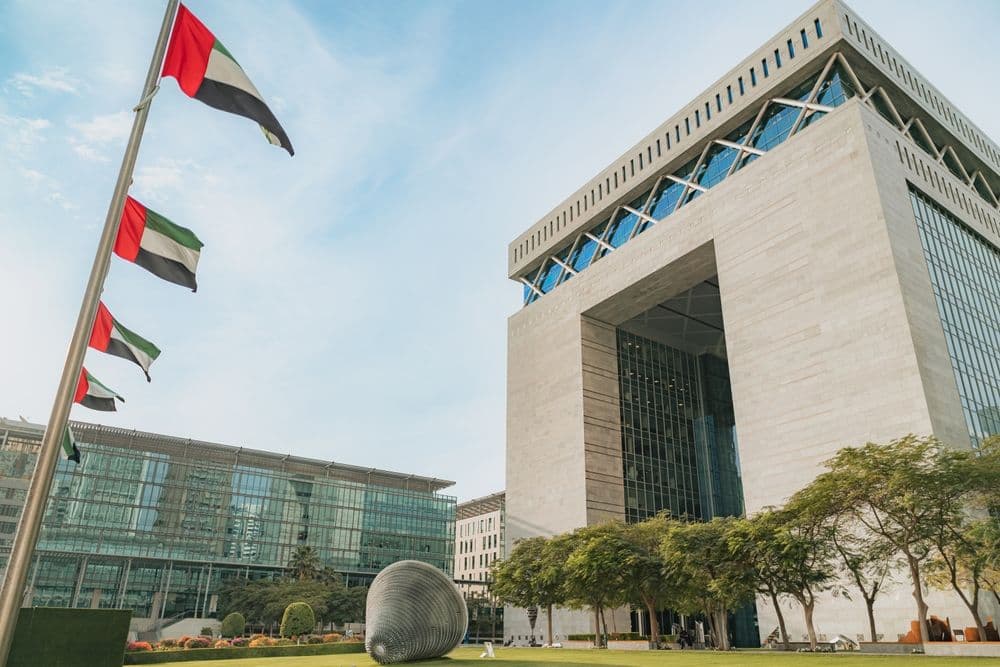
 The Dubai International Financial Centre will host Payrails’ new regional headquarters. (Shutterstock)
Payrails, which describes itself as the financial operating system for global enterprises, has built its business on modular, enterprise-grade payment infrastructure designed to help large organizations streamline and scale cross-border payment operations. The company stated that its regional headquarters will be based in Dubai’s leading financial free zone, aligning with its long-term strategy to support complex payment ecosystems in the Middle East, Africa and South Asia (MEASA) region.
In both global and regional markets, the fintech landscape has become increasingly crowded, with established players and ambitious startups vying for enterprise clients and strategic partnerships. For a company like Payrails, which already supports large enterprise merchants such as Careem and Majid Al-Futtaim, proximity to customers and partners is central to deepening commercial relationships and navigating evolving regulatory environments.
Orkhan Abdullayev, CEO of Payrails, said, “Global businesses today need financial infrastructure that can adapt as quickly as they do. DIFC offers the innovation environment, institutional trust, and ecosystem depth required to support ambitious companies scaling across the Middle East and beyond. Establishing our regional headquarters in Dubai allows us to work more closely with both regional champions and global businesses operating in the region, while building on a foundation designed for long-term scale and reliability.”
The choice of DIFC as Payrails’ regional hub is notable. Created in 2004 as a special economic zone, DIFC has grown into one of the Middle East’s most prominent financial centers, offering a common-law legal system, independent regulatory framework, and tax incentives designed to attract international financial services firms.
Dubai and the UAE more broadly view fintech expansion as part of a wider economic diversification strategy. Over the past decade, authorities have worked to position the emirate as a gateway between East and West, using regulatory reforms, financing initiatives, and global partnerships to attract firms across sectors ranging from digital assets to payments processing. While much of the spotlight has centered on consumer-facing fintechs, enterprise financial infrastructure companies like Payrails are increasingly regarded as key enablers of regional digital commerce.
Salmaan Jaffery, Chief Business Development Officer at DIFC Authority, highlighted that Payrails’ entry adds value to the center’s community of innovation-focused firms. “We are confident that Payrails will play a pivotal role in driving innovation and accelerating the digital transformation of financial services within the region.”
Payrails’ technology is built around what the company calls a modular financial operating system, which consolidates functions such as provider-agnostic routing, automated reconciliation, dispute management, and unified analytics. In practical terms, this means businesses can reduce operational complexity by integrating disparate payment systems and data flows into a single platform. This is particularly important for enterprises operating across multiple markets, a challenge that traditional banking and payment systems have tended to address with fragmented or siloed solutions.
While the company has historically been headquartered in Europe, its regional momentum has been building for months. In 2024, Payrails announced a strategic partnership with Careem, integrating dynamic payment routing solutions with Careem’s regional payments infrastructure to accelerate market expansion and integrate local payment methods more seamlessly.
Companies like Payrails often benefit from having a physical presence in markets where regulatory frameworks, commercial dynamics, and cultural nuances influence how fintech solutions are adopted. Establishing operations within the region signals long-term commitment and enables closer engagement with regulators, enterprise clients, and ecosystem partners, strengthening both commercial relationships and market understanding.
Critically, the move comes at a time when global financial infrastructure firms are recalibrating their regional strategies in response to rising demand for robust payment systems. The Middle East’s adoption of digital commerce has accelerated sharply in recent years, driven by e-commerce growth, cross-border trade, and evolving consumer expectations around payment convenience and security. These trends are matched by increased regulatory focus on financial infrastructure and digital transformation initiatives across nations. Experts say that companies capable of delivering enterprise-grade solutions without requiring extensive in-house development are likely to be among the fastest-growing players in the fintech ecosystem.
Dubai and the broader Gulf region see the arrival of firms such as Payrails as further strengthening their reputation as hubs not only for venture capital-backed startups but also for mature, enterprise-focused technology companies that generate jobs, innovation and cross-border business ties. Payrails has indicated it will tap into DIFC’s ecosystem, home to major banks, global technology companies, and regional financial institutions, to broaden its product capabilities and deepen its market presence.
Nasdaq Dubai welcomes Ajman Bank’s $300 million Sukuk
Everyday finance gets a Tabby upgrade

ADI Chain steps up global expansion
e& closes a major investment chapter

Stay ahead with the latest updates, insights, and trends shaping the world of finance, investment, blockchain, digital business, fintech, technology, and global markets.
