

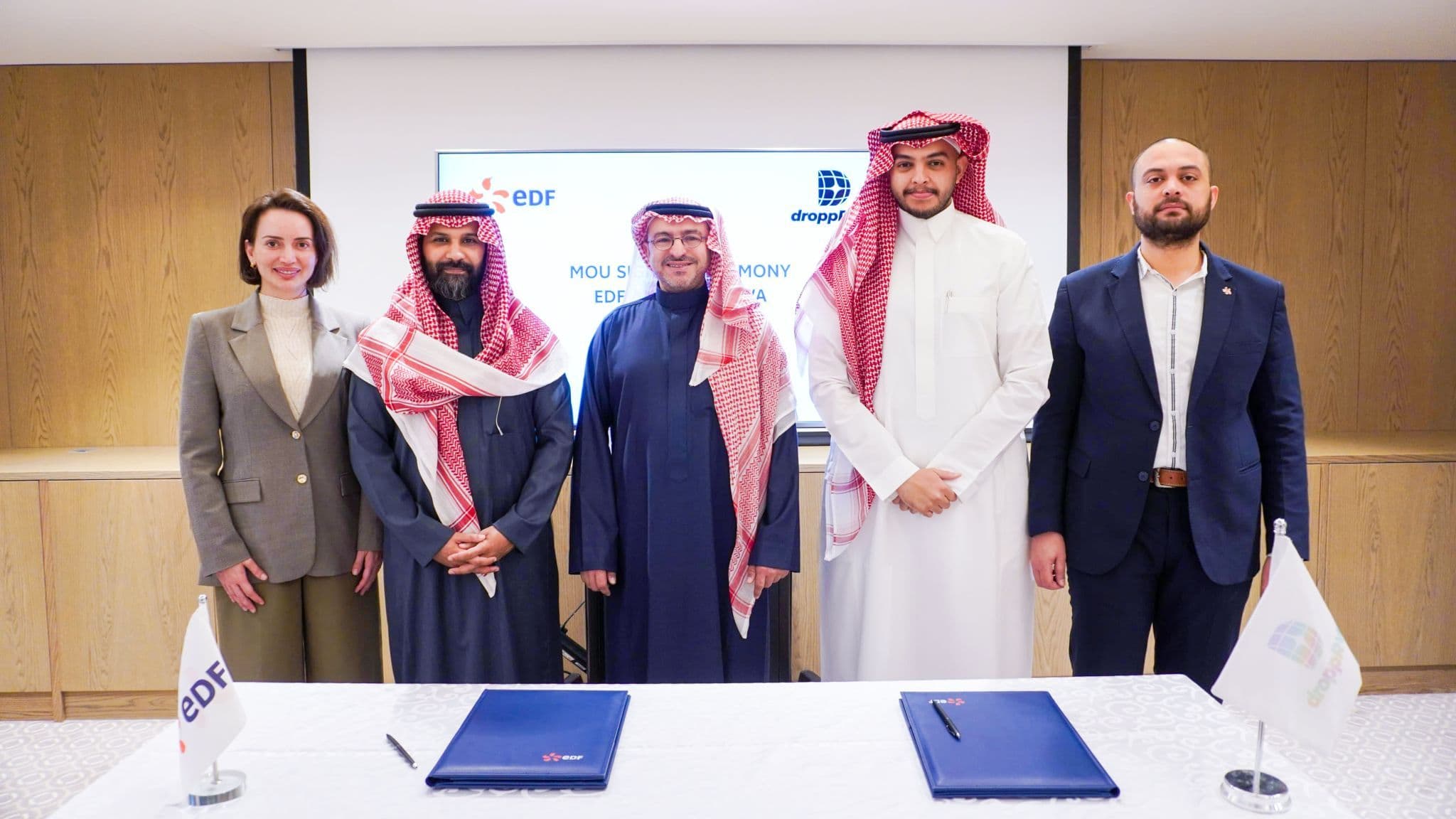
 Energy group EDF is exploring the use of blockchain-based tokenization in collaboration with droppRWA, as part of an initiative focused on potential applications within Saudi Arabia’s energy sector. (Image Source: EDF Middle East)
The partnership was formalized through a memorandum of understanding signed in Riyadh and reflects a growing interest among major industrial players in exploring how digital asset technologies might fit into traditionally capital-heavy sectors.
As one of the world’s largest electricity producers, EDF operates across power generation, transmission, and energy services, supplying electricity to tens of millions of customers worldwide. While EDF has already adopted digital tools to improve grid management and operational efficiency, its engagement with tokenization marks a more exploratory step, aimed at reassessing how large-scale energy assets could be financed, managed, and accessed by investors over time. The collaboration was first disclosed through industry reporting and EDF’s own corporate communications.
Under the MoU, EDF and droppRWA will examine whether blockchain-based systems can be used to digitally represent real-world energy assets. This includes assessing whether infrastructure such as power plants or related facilities could be tokenized, allowing ownership or economic interests to be divided into smaller units. In theory, this could improve liquidity and broaden access to capital by enabling a wider range of investors to participate. Tokenization involves converting rights linked to physical or financial assets into digital tokens recorded on a blockchain, where they can be tracked, transferred, or settled with greater transparency than conventional systems.
The collaboration also looks beyond asset ownership to the operational side of the energy value chain. Large energy projects often involve complex webs of contractors, suppliers, financiers, and operators, with settlement and reconciliation processes that can be slow and resource-intensive. By exploring distributed ledger technology for inter-company transactions, the partners aim to assess whether these processes could be streamlined while still meeting regulatory and governance requirements.
Another focus area is carbon markets and the environmental attributes associated with energy production. Carbon credits have long faced issues related to verification, transparency, and the risk of double counting. Blockchain-based registries are increasingly being explored as a way to improve traceability and auditability in these markets. EDF and droppRWA will assess whether tokenised frameworks could offer more reliable tracking of carbon credits or sustainability-linked instruments tied to energy assets, based on publicly available descriptions of the initiative.
DroppRWA describes itself as a real-world asset tokenization platform designed for institutional and sovereign-grade use cases. Headquartered in Bermuda, the company operates across several major financial and regulatory hubs, including Riyadh, London, and Dubai. Its technology is built to integrate compliance checks, identity verification, and governance rules directly into the tokenization process, with the aim of making blockchain-based asset issuance compatible with regulated financial environments.
The firm has already been involved in tokenisation initiatives in the Gulf region, including participation in Saudi Arabia’s first tokenized real estate transaction through private-sector partnerships. Although these projects have been relatively small in scale, they have helped establish early operational and regulatory reference points that could influence future tokenisation efforts in other asset classes, including energy.
Omar AlDaweesh, CEO of EDF Saudi Arabia, noted, “At EDF, we are committed to supporting the Kingdom’s energy goals through innovation. Exploring the potential of asset tokenization and next-generation financial technology allows us to look beyond traditional frameworks.”
From droppRWA’s perspective, Chairman Faisal Al Monai, added, “Energy infrastructure is long term, capital intensive, and tightly regulated. Yet globally, the financial models behind it have changed far less than the systems they support. Tokenization in the energy sector has so far remained largely at pilot level or limited to individual assets. Our collaboration is about exploiting the energy sector and being able to tokenize a market that always required heavy capital to access.”
The partnership also fits within broader shifts in Saudi Arabia’s economic strategy under Vision 2030, which places strong emphasis on diversification, technology adoption, and innovation in infrastructure financing. In recent years, the Kingdom has accelerated efforts to modernize its capital markets, attract foreign investment, and deploy advanced technologies across key sectors, including energy and financial services. Within this context, tokenization has increasingly been discussed as a potential tool for improving market efficiency and mobilizing capital.
Despite the promise, tokenizing physical energy assets remains a complex undertaking. Regulatory clarity across jurisdictions, legal recognition of tokenized ownership rights, cybersecurity risks, and integration with existing operational systems all pose significant challenges. Energy infrastructure is also subject to strict safety and environmental standards, meaning any blockchain-based solution must work seamlessly within established compliance frameworks.
As a result, the EDF–droppRWA collaboration is expected to involve extended periods of technical analysis, legal review, and pilot testing before any commercial deployment is considered. While the ultimate outcome remains uncertain, the initiative highlights a growing willingness among major industrial groups to look beyond traditional finance and explore how blockchain technology might be applied to the core assets that underpin national energy systems.
For an industry that has historically been cautious in adopting new financial technologies, the project may offer an early indication of how tokenization could move from theory to real-world experimentation.

From science Olympiad to Silicon Valley

Saudi startup scales its AI ambitions
Nasdaq Dubai welcomes Ajman Bank’s $300 million Sukuk
Everyday finance gets a Tabby upgrade

Stay ahead with the latest updates, insights, and trends shaping the world of finance, investment, blockchain, digital business, fintech, technology, and global markets.
