Dubai is moving several university-born technology ventures from research labs into real-world commercial testing as the emirate deepens its push to position itself as a global innovation hub.
The initiative, known as Dubai Future Solutions – Prototypes for Humanity, is supporting startups from Switzerland, the United States, and Egypt as they begin pilot deployments and commercial expansion efforts in the UAE.
The program is operated through a partnership involving the Dubai Future Foundation, Dubai International Financial Centre (DIFC), Art Dubai, and the Hussain Sajwani-DAMAC Foundation. Organizers say the initiative is designed to bridge a persistent problem in global innovation: transforming academic research into scalable businesses.
Turning Innovation Into Scalable Businesses
While universities continue producing breakthroughs in artificial intelligence, biotechnology, and advanced materials, many projects struggle to move beyond research environments because of funding gaps, regulatory hurdles, or limited commercial support.
Dubai’s approach appears focused on solving that bottleneck by creating a structured environment where startups can test technologies directly with government entities, investors, and industry partners.
The program currently supports 100 startups selected from thousands of submissions submitted by universities worldwide. The selected ventures receive operational support, funding access, business development assistance, and opportunities for pilot testing inside the UAE.
Three ventures are now advancing into deployment phases within the country.
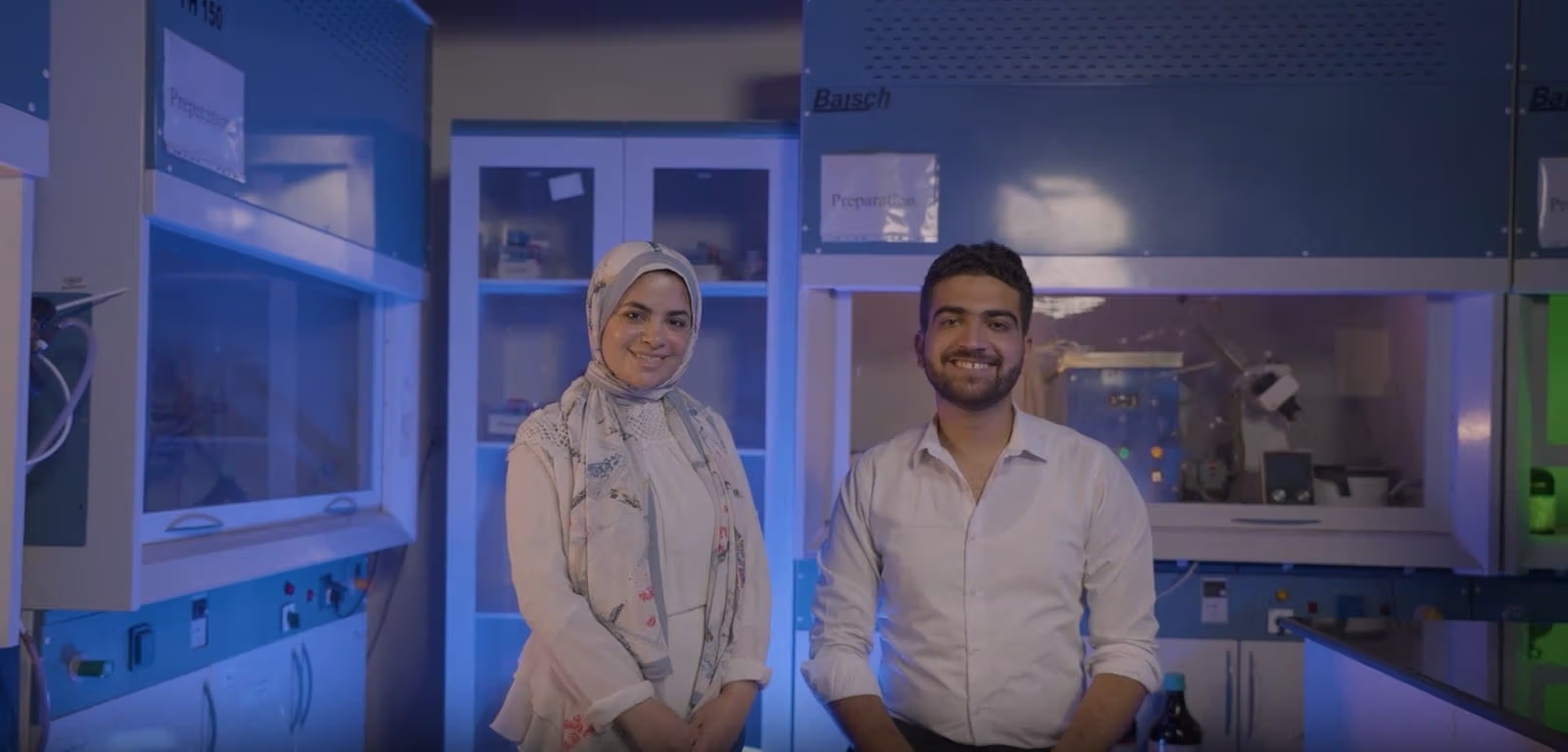
One of them is Switzerland-based Oxara, which develops low-carbon construction materials designed to reduce cement waste and carbon emissions in the building sector. Another is Egypt’s P-Vita, an agricultural biotechnology venture focused on improving crop resilience and productivity. The third is Virufy from the United States, which uses AI-powered respiratory analysis technology for disease monitoring and screening.
The projects span industries that align closely with the UAE’s long-term economic diversification strategy, particularly healthcare technology, sustainable infrastructure, and food security.
Dubai’s Broader Innovation Strategy
The expansion of the program reflects a wider effort by Dubai to attract emerging technology companies and research talent into the emirate.
Over the past decade, the UAE has invested heavily in future-focused initiatives tied to artificial intelligence, advanced mobility, sustainability, robotics, and digital infrastructure. Institutions such as the Dubai Future Foundation and the Museum of the Future have become central to that positioning strategy.
His Excellency Khalfan Belhoul, CEO of the Dubai Future Foundation, said: “Through the ‘Dubai Future Solutions – Prototypes for Humanity’ initiative, we are building a structured pathway that takes breakthrough research from the lab to real world deployment and scalable ventures. Dubai offers something few places can, an integrated environment where government, industry, and capital align to test, refine, and scale solutions at speed. At the Dubai Future Foundation, our role is to support this journey end to end by connecting global talent with local partners and transforming scientific potential into tangible impact across sectors.”
Rather than treating startups as isolated ventures, the program attempts to integrate government support, private capital, and operational testing within one ecosystem. That model has become increasingly important globally as governments compete to attract high-growth technology sectors.
His Excellency Arif Amiri, CEO of the DIFC Authority, said: “DIFC’s founding partnership in ‘Prototypes for Humanity’ reflects our conviction that the most durable economic ecosystems are built on the ability to attract, support and retain the world’s most capable innovators. The programme’s global pool of innovators is ready to be leveraged to build even more competitive advantage for the public and private sectors in Dubai, a city where a deep ecosystem of capital, institutions and government help them succeed.”
The Challenge of Turning Research Into Business
Many early-stage scientific innovations fail not because the technology lacks value, but because researchers often lack access to business infrastructure, industry relationships, or regulatory pathways.
That gap between invention and commercialization has become a major challenge worldwide, particularly in deep-tech sectors where development timelines are longer and operational costs are higher.
Dubai’s model appears aimed at accelerating that transition period by allowing startups to operate within a concentrated ecosystem of investors, regulators, government agencies, and multinational companies.
Emerging ventures can also use pilot projects in the UAE as proof-of-concept deployments before expanding into broader international markets.
The initiative may additionally strengthen Dubai’s reputation among global universities and research institutions seeking commercialization partners outside traditional Western startup hubs.
The Global Race for Emerging Technologies
Dubai’s expansion of university venture programs comes at a time when countries across the Gulf are aggressively investing in technology ecosystems as part of post-oil economic diversification strategies.
The UAE, Saudi Arabia, and Qatar have all increased spending on AI infrastructure, startup funding, digital transformation, and research partnerships over recent years.
Dubai, however, has increasingly focused on positioning itself as a rapid deployment environment where startups can move from concept testing into operational implementation faster than in many larger markets.
That pitch may become more attractive to founders navigating slower regulatory systems elsewhere.
The UAE’s combination of government-backed funding initiatives, free economic zones, and international business connectivity continues to play a major role in attracting foreign startups and researchers.
Applications Open for 2027 Program
Organizers also confirmed that applications are now open for the next edition of the Dubai Future Solutions – Prototypes for Humanity summit, scheduled to take place in Dubai later this year.
The event invites students, graduates, and researchers from universities worldwide to submit projects for consideration in the 2027 venture program.
The wider initiative engages thousands of academic participants annually and is positioned as one of the world’s largest university innovation and entrepreneurship platforms.