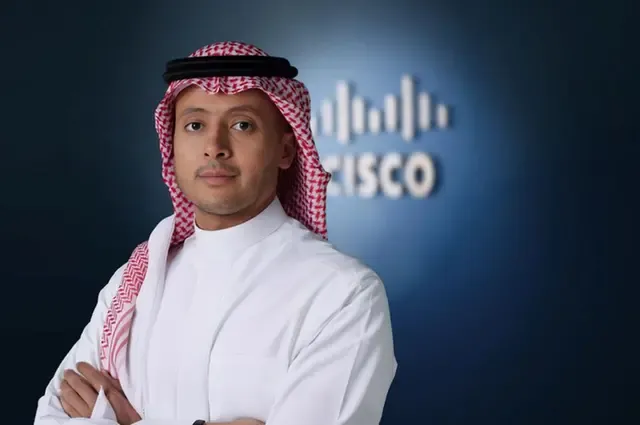
Cisco Systems has appointed Bader Almadi as Vice President for Saudi Arabia, placing a seasoned technology executive at the center of one of the region’s most ambitious digital transformation efforts.
The appointment reflects Cisco’s growing focus on the Kingdom as it accelerates investments in artificial intelligence, cloud infrastructure, and broader digital capabilities.
Based in Riyadh, Almadi will oversee Cisco’s strategy and commercial operations across Saudi Arabia. His mandate goes beyond day-to-day business management. It includes building partnerships and expanding infrastructure that supports the country’s long-term economic transformation plans.
Saudi Arabia has positioned technology as a central pillar of its diversification strategy under Vision 2030, with increasing emphasis on AI, data infrastructure, and digital services across industries. Cisco’s leadership change appears aligned with that broader trajectory.
Almadi’s role will involve helping organizations across sectors adopt advanced technologies, including financial services, energy, hospitality, and entertainment, industries that are being reshaped by digitalization at different speeds but toward a similar endpoint.
Almadi brings more than two decades of experience in enterprise technology and leadership. Before joining Cisco, he served as Managing Director for Google Cloud in Saudi Arabia, where he played a role in expanding cloud infrastructure and driving digital transformation initiatives across multiple sectors.
His previous experience also includes leadership positions at companies such as Dell Technologies, Oracle, and EMC, giving him exposure to both infrastructure and enterprise software ecosystems.
That combination matters. Saudi Arabia’s digital ambitions are not limited to a single vertical. They require coordination across cloud, connectivity, cybersecurity, and applications, areas where Almadi has worked from multiple angles.
Beyond corporate roles, he has also contributed to national-level initiatives, advising the Ministry of Communications and Information Technology and participating in international forums such as the G20 Digital Economy Taskforce.
Cisco is not new to the Saudi market. The company has operated in the Kingdom for nearly three decades, playing a role in building foundational networking infrastructure that supports both public and private sector operations.
In recent years, that presence has evolved. The focus has shifted from traditional networking toward more advanced capabilities, including AI-driven solutions, cloud services, and cybersecurity frameworks.
Part of that strategy includes large-scale infrastructure initiatives. Cisco has highlighted investments tied to AI capacity and partnerships aimed at supporting data-intensive applications across industries.
The company has also emphasized workforce development through programs like its Networking Academy, which has trained hundreds of thousands of learners in the Kingdom, an effort that aligns with broader national goals around digital skills and employment.
While artificial intelligence is often discussed in abstract terms, the reality is more practical. It requires physical infrastructure, reliable connectivity, and skilled talent.
Cisco’s strategy in Saudi Arabia appears to focus on all three. The company’s approach includes supporting data centers, enabling secure cloud environments, and building partnerships that allow enterprises to adopt AI at scale. These are not headline-grabbing consumer products, but they form the underlying systems that make large-scale digital transformation possible.
Almadi’s appointment suggests a push toward execution rather than planning. Saudi Arabia has already outlined its ambitions. The next phase involves turning those ambitions into operational systems that can support real economic activity.
On the surface, this is a standard executive appointment. Companies make them all the time. But context changes the weight of the story. Saudi Arabia is investing heavily in becoming a regional and global technology hub. That ambition depends not just on funding, but on execution, on people who can connect strategy with infrastructure and partnerships.
Cisco, as a provider of networking and enterprise technology, sits in a position that is less visible than consumer-facing companies but no less critical. It helps build the systems that other technologies rely on.
Appointing a local leader with both international experience and regional insight is a signal that the company sees Saudi Arabia not just as a market, but as a long-term strategic base.
The Middle East’s technology landscape is shifting. Governments are investing in AI, cloud, and digital infrastructure at a pace that is beginning to translate into tangible projects.