

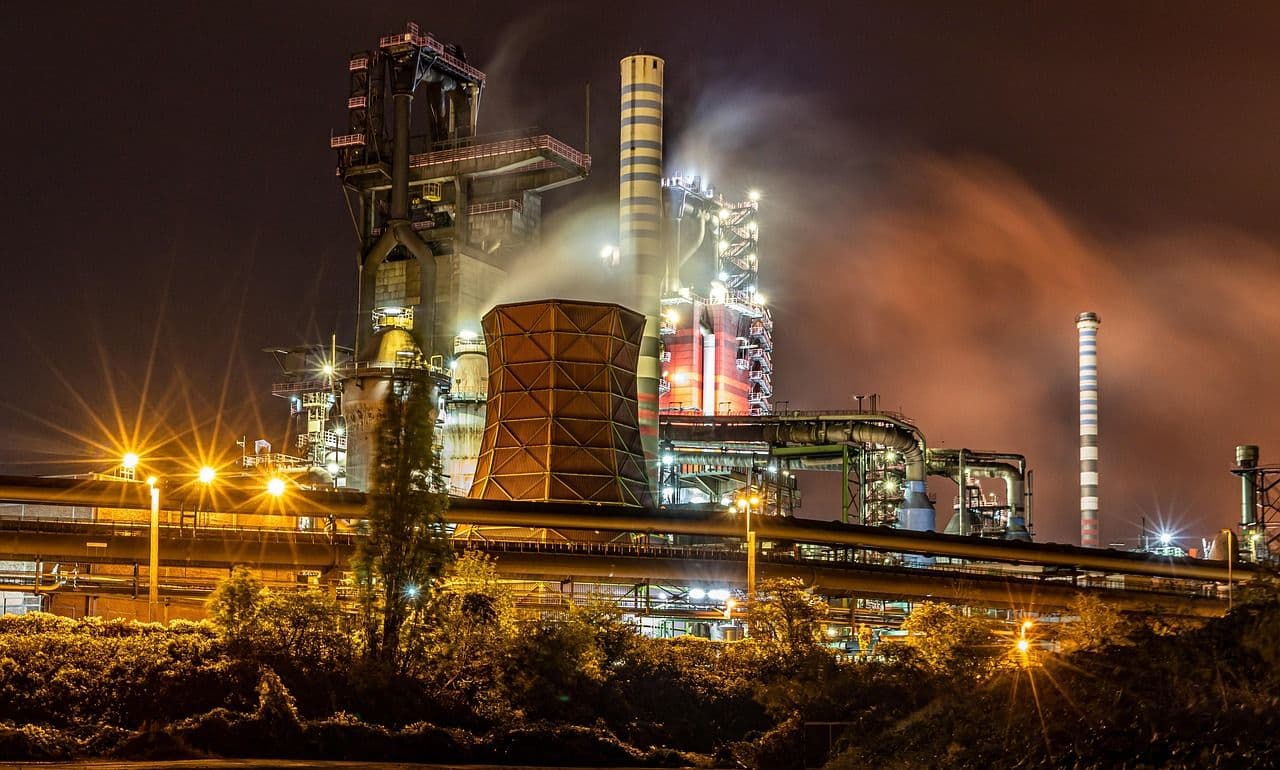
 Heavy industry powers the global economy, but it also carries a significant energy footprint, pushing investors and innovators to rethink how these systems operate. (Pixabay)
Via Separations, a Massachusetts-based startup specializing in membrane-based filtration systems, has raised $36 million in a new funding round supported by Aramco Ventures, alongside Climate Investment and Marathon Petroleum. The company confirmed the raise in an official press release, outlining plans to scale commercial deployments and expand into refining and chemicals markets.
The funding marks another step in Aramco Ventures’ strategy to invest in technologies that can reduce emissions across industrial value chains, particularly in sectors where decarbonization remains complex and capital-intensive.
Via Separations is developing advanced membrane systems designed to replace traditional thermal separation processes, which are widely used in industries such as oil refining, petrochemicals, and chemicals manufacturing. These conventional processes rely heavily on heat, making them among the most energy-intensive operations in industrial production. By contrast, membrane-based systems can separate materials using significantly less energy, offering a pathway to both cost savings and emissions reduction.
According to the company, its technology has the potential to cut energy consumption in certain separation processes by as much as 90%, depending on the application. The latest funding will be used to accelerate the deployment of these systems in real-world industrial settings, moving beyond pilot phases into broader commercial adoption.
While the round includes multiple investors, the involvement of Aramco Ventures stands out in a regional context.
As the venture capital arm of Saudi Aramco, Aramco Ventures has been actively expanding its exposure to technologies that align with long-term shifts in energy systems. This includes carbon capture, hydrogen, and now industrial efficiency solutions such as advanced filtration.
The investment reflects a broader pattern across the Gulf, where state-linked entities are not only funding renewable energy projects but also targeting innovations that improve the efficiency of existing industrial infrastructure.
Aramco can use this approach to address emissions within core operations such as refining and petrochemicals, rather than relying solely on external energy transition narratives.
The Via Separations deal illustrates how Gulf capital is increasingly moving into global deep tech ecosystems, particularly in areas tied to industrial transformation.
Rather than focusing exclusively on software or consumer-facing startups, investors in the region are showing growing interest in technologies that can be deployed across large-scale industrial systems. These include solutions for energy efficiency, emissions reduction, and process optimization.
This shift aligns with broader economic strategies across the Middle East, including Saudi Arabia’s Vision 2030, which emphasizes diversification, industrial development, and sustainability.
By backing companies like Via Separations, regional investors are effectively positioning themselves at the intersection of traditional energy industries and emerging climate technologies.
One of the key challenges for companies like Via Separations is scaling from laboratory success to full industrial deployment.
Membrane technologies have long been studied in academic settings, but integrating them into existing industrial processes requires significant engineering, capital, and operational validation.
The company’s latest funding round is aimed at bridging that gap, enabling it to deploy its systems in commercial environments where performance, reliability, and cost-effectiveness can be tested at scale.
The participation of industrial players such as Marathon Petroleum further reinforces this focus on practical implementation, rather than purely experimental innovation.
The investment also reflects a growing recognition that improving efficiency within existing systems can play a critical role in reducing global emissions.
While renewable energy continues to expand, industries such as refining and chemicals are expected to remain essential components of the global economy for decades. Technologies that reduce their environmental footprint without disrupting operations are therefore gaining increased attention.
Gulf-based investors now have an opportunity to leverage existing expertise in energy and industrial systems while participating in the development of next-generation technologies.
The Via Separations funding round does not represent a dramatic shift in strategy, but rather a continuation of a gradual evolution.
Investments of this kind suggest that regional players are taking a more nuanced approach to the energy transition, one that balances innovation with the realities of existing infrastructure.
Instead of framing the transition as a binary shift away from traditional energy, these moves point toward a more integrated model, where efficiency, sustainability, and industrial performance are addressed simultaneously.
With more capital flowing into similar technologies, the Middle East’s role in shaping industrial climate solutions may become increasingly visible, not just as a producer of energy but also as an investor in using that energy more efficiently.
Dubai approval brings Revolut closer
ADI Chain steps up global expansion
Abu Dhabi backs round-the-clock clean power
e& closes a major investment chapter

Stay ahead with the latest updates, insights, and trends shaping the world of finance, investment, blockchain, digital business, fintech, technology, and global markets.
