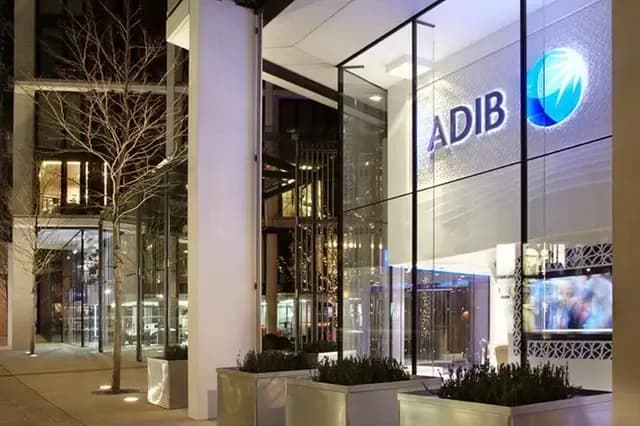
Abu Dhabi Islamic Bank (ADIB) is steadily turning its sustainability ambitions into measurable financial activity, with the lender mobilizing approximately $5.53 billion (AED 20.3 billion) in sustainable finance by the end of 2025.
The figure reflects a growing emphasis on environmental, social, and governance (ESG) financing within the UAE’s banking sector, where institutions are increasingly aligning capital allocation with long-term economic and climate-related priorities.
Rather than remaining a strategic talking point, sustainable finance is now becoming a visible component of how banks in the region operate and compete.
A Shift from Commitments to Capital Deployment
For years, financial institutions across the Gulf have outlined sustainability targets, often tied to national development agendas and climate commitments. What is beginning to change is the pace at which those targets are being translated into actual financing.
ADIB’s reported $5.53 billion (AED 20.3 billion) milestone signals that ESG-linked activity is no longer confined to pilot initiatives or isolated deals. Instead, it is evolving into a structured and expanding segment of the bank’s broader financing operations.
The bank has also set a longer-term goal of mobilizing AED 60 billion in sustainable finance by 2030, placing its current progress within a wider multi-year trajectory.
This type of forward-looking target reflects a broader industry pattern, where sustainability is increasingly integrated into balance sheets rather than treated as a separate or experimental function.
What Drives Sustainable Finance Growth
Sustainable finance, in practical terms, covers a range of activities. These typically include funding for renewable energy projects, sustainability-linked financing for corporations, and participation in capital markets instruments designed to meet environmental or social criteria.
In the Gulf region, demand for such financing has grown alongside government-led initiatives focused on energy transition, infrastructure development, and economic diversification.
Banks are responding not only to regulatory direction but also to investor expectations, as global capital increasingly favors institutions that can demonstrate credible ESG alignment.
ADIB structures financial products that meet both sustainability standards and Sharia compliance requirements, an intersection that adds complexity while opening access to a distinct segment of investors.
The Role of Islamic Finance
One of the more notable aspects of ADIB’s approach is how it integrates sustainable finance within an Islamic banking framework.
Islamic finance emphasizes ethical investment, asset-backed transactions, and risk-sharing principles. These characteristics naturally overlap with ESG priorities, which focus on responsible capital allocation and long-term value creation.
This alignment has enabled Islamic financial institutions to participate more actively in sustainability-linked markets, including the issuance and structuring of sukuk tied to environmental or social objectives.
As a result, sustainable finance in the region is not simply being adopted, it is being adapted to fit existing financial systems and cultural frameworks.
Regional Context: A Competitive ESG Landscape
ADIB’s progress reflects a wider transformation across the UAE and the broader Middle East, where sustainability is becoming a key area of competition among financial institutions.
Banks are increasingly positioning themselves as partners in national development strategies, particularly those related to climate targets and economic diversification.
This shift is reinforced by the UAE’s long-term policy direction, which places sustainability at the center of future growth. Financial institutions, in turn, are expected to support that transition by channeling capital into sectors such as clean energy, infrastructure, and technology.
Within this environment, ESG performance is no longer just a reputational factor. It is becoming a measurable indicator of strategic execution.
Momentum with Measurable Progress
The reported 5.53 billion (AED 20.3 billion) in sustainable finance suggests that ADIB is gaining traction in this evolving space. While the figure itself is significant, what stands out is the consistency of growth implied by the bank’s broader targets.
Sustained expansion in ESG-linked financing typically requires more than isolated deals. It involves developing internal frameworks, building expertise, and aligning business units around new types of risk assessment and opportunity identification.
That process appears to be underway, as sustainable finance moves closer to the core of banking operations rather than remaining a specialized niche.
The Importance of Transparency Going Forward
As sustainable finance grows, so does scrutiny. Investors and stakeholders are paying closer attention not just to the volume of financing, but to how that capital is defined, measured, and reported. The credibility of ESG claims increasingly depends on transparency and consistency in disclosure.
Banks face both an opportunity and a challenge. Strong reporting can reinforce investor confidence, while vague or inconsistent metrics may raise questions about the real impact of sustainability initiatives.
In this context, future updates and detailed disclosures will play an important role in shaping how institutions like ADIB are evaluated in global markets.
With its 2030 target in place, ADIB’s next phase will likely focus on scaling its sustainable finance activities while maintaining clarity around impact and performance.
The broader direction is clear. Sustainable finance is no longer emerging, it is becoming embedded.
ADIB’s latest milestone represents more than a numerical achievement. It reflects a structural shift in how capital is being deployed, aligning financial growth with long-term environmental and social considerations.
And in a region moving quickly to redefine its economic future, that alignment may prove just as important as the capital itself.