

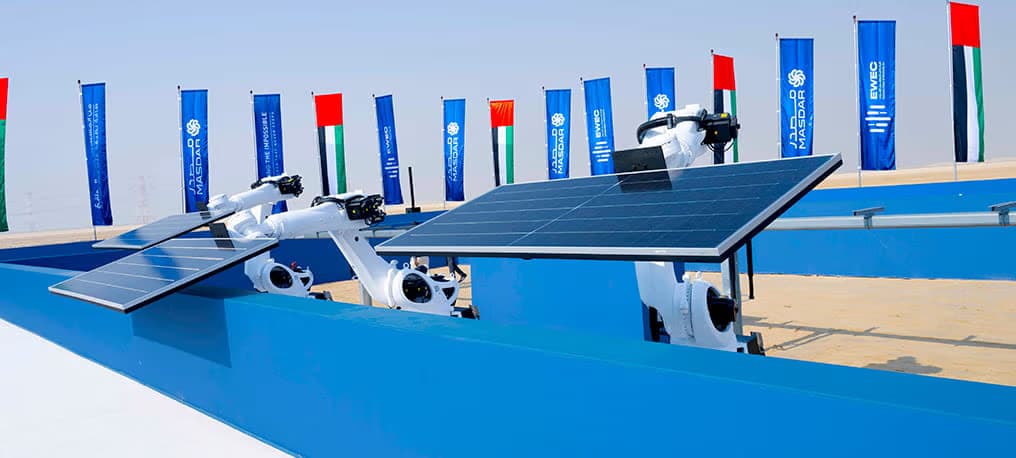
 Masdar’s planned Abu Dhabi project will pair 5.2GW of solar capacity with 19GWh of battery storage to deliver renewable power around the clock. Credit: Masdar (Image source: Masdar)
Abu Dhabi clean energy company Masdar has reached financial close on a $6.1 billion renewable energy project that will combine one of the world’s largest solar developments with a vast battery storage system. The financing milestone moves the project beyond its early development and construction commitments, giving it the capital structure needed to advance toward planned operations in 2027.
A consortium of 13 international and regional lenders is providing a $5.1 billion financing package, while Masdar is contributing $1 billion in equity. The lending group includes Abu Dhabi Commercial Bank, Abu Dhabi Islamic Bank, BNP Paribas, Bank of China, Crédit Agricole Corporate and Investment Bank, Dubai Islamic Bank, First Abu Dhabi Bank, HSBC, KfW IPEX-Bank, Natixis, Sumitomo Mitsui Banking Corporation, Standard Chartered and Societe Generale.
Reaching financial close means the principal financing agreements and conditions required to fund the development have been completed. In practical terms, the milestone offers a clearer indication that banks have evaluated the project’s contracts, technology, expected revenue and construction risks and are prepared to provide long-term capital. The unusually broad lender group also spreads financing exposure across institutions based in the UAE, Europe and Asia.
Masdar Chief Financial Officer Mazin Khan said: “This significant financing commitment demonstrates the confidence of the international banking community not only in a landmark project but also in Masdar's financial strength, disciplined execution and long-term growth strategy. This milestone further demonstrates our ability to mobilize global capital at scale while delivering innovative renewable infrastructure that supports long-term economic growth and energy security.”
The project is being developed in Abu Dhabi by Masdar in partnership with Emirates Water and Electricity Company, the entity responsible for procuring water and electricity supplies across the emirate. Its design combines a 5.2-gigawatt solar photovoltaic plant with a 19-gigawatt-hour battery energy storage system, creating an integrated facility intended to deliver 1 gigawatt of continuous power.
Solar facilities normally generate electricity according to available sunlight, leaving output exposed to changes in weather and the daily transition into nighttime. The Abu Dhabi development is designed around a different operating model. Electricity produced in excess of immediate requirements during daylight hours will be stored in the battery system and dispatched when solar generation falls, allowing the project to maintain a more stable supply.
Masdar describes the facility as the world’s first gigascale, round-the-clock renewable energy project. EWEC similarly identifies it as the first large-scale combined solar and battery project designed to supply 1 gigawatt of baseload power throughout the day. The “world-first” description remains a characterization made by the project’s developers, but the announced scale places the development among the most ambitious attempts to pair utility-scale solar generation with long-duration battery capacity.
Construction began with a groundbreaking ceremony in October 2025, and Masdar expects the facility to become operational in 2027. The project’s 5.2 gigawatts of solar capacity is more than five times its targeted continuous output, reflecting the amount of daytime generation required both to serve the grid and charge the batteries for later use. Its 19 gigawatt-hours of storage would theoretically equal 19 hours of energy at a discharge rate of 1 gigawatt, although actual performance will depend on operating reserves, system efficiency and dispatch conditions.
The financing represents more than a large capital raise for a single generation asset. It provides an early commercial test of whether solar power and battery storage can be financed together as infrastructure capable of supplying predictable electricity, rather than operating mainly when weather conditions permit. Banks financing the project are effectively placing capital behind a model that seeks to convert variable solar generation into a scheduled, continuous product.
Battery economics are central to the project’s commercial case. Falling storage costs, longer battery life and improvements in system efficiency are making large-scale solar-and-storage developments more practical to finance and operate. Masdar’s Abu Dhabi project could therefore provide an important test of whether this model can be replicated in other markets.
Demand patterns are also changing the investment case for dependable power. Data centers, artificial intelligence infrastructure and advanced manufacturing facilities require large volumes of electricity with limited tolerance for interruptions. Renewable projects that can offer a firmer and more predictable supply may therefore have access to customers and financing structures that are not always available to conventional solar developments.
The Abu Dhabi project also sits within Masdar’s broader expansion strategy. The company reported a global clean energy portfolio of more than 65 gigawatts in early 2026 and is targeting 100 gigawatts by 2030. Masdar is owned by Abu Dhabi National Oil Company, Mubadala Investment Company and Abu Dhabi National Energy Company, better known as TAQA, giving it the backing of three of the emirate’s largest state-controlled companies.

Meta backs away from Instagram AI tool

Saudi esports strategy moves beyond Riyadh

New leadership for VinFast’s regional ambitions
Dubai becomes Nestlé’s MENA innovation base

Stay ahead with the latest updates, insights, and trends shaping the world of finance, investment, blockchain, digital business, fintech, technology, and global markets.
