Dubai has launched DEWA International, a wholly owned subsidiary of Dubai Electricity and Water Authority.
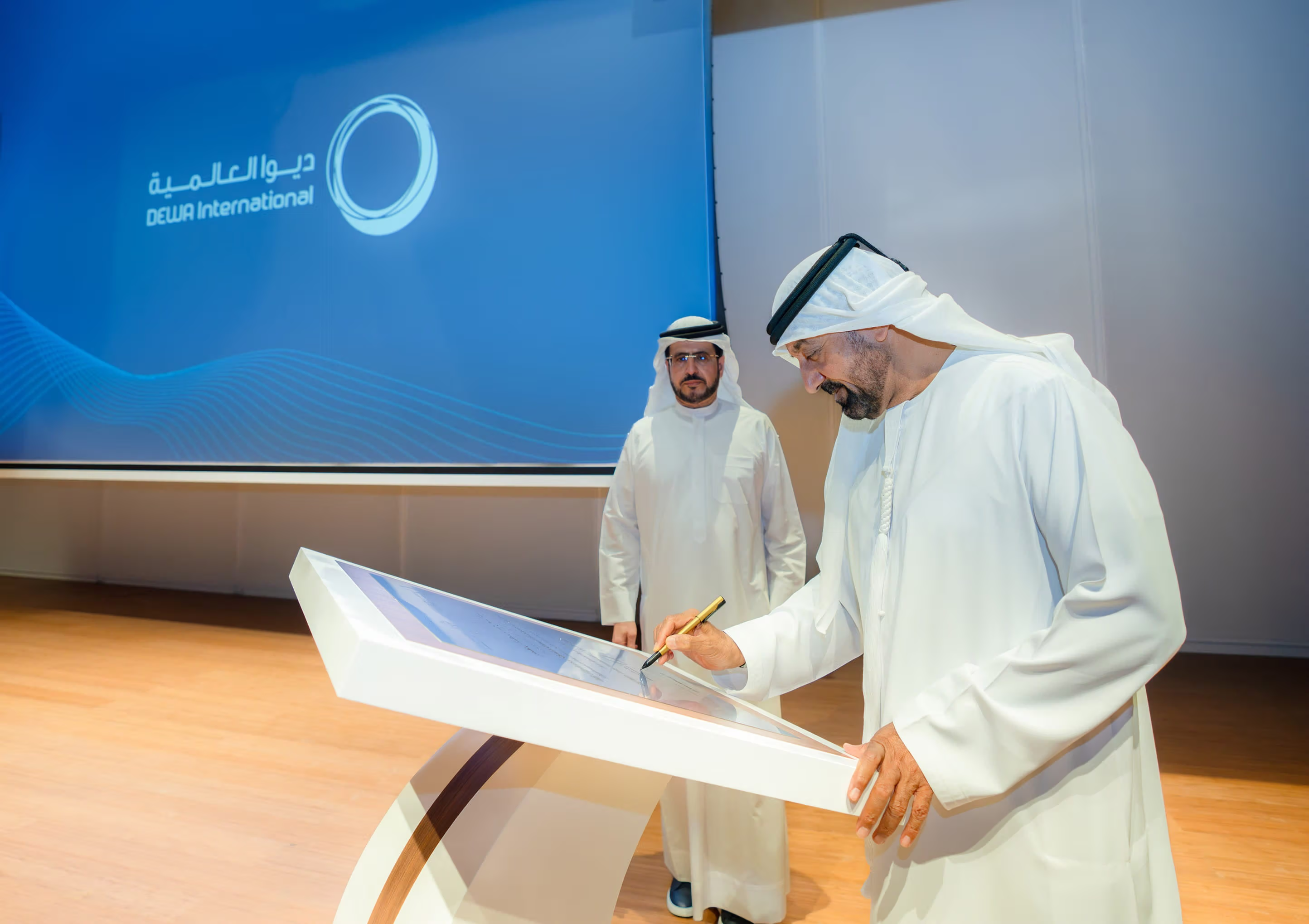
The new company was announced by Sheikh Ahmed bin Saeed Al Maktoum, Chairman of the Dubai Supreme Council of Energy, during an event held at Al Shera’a, DEWA’s new headquarters. The launch was attended by senior UAE officials, energy executives, investors and strategic partners.
A Global Platform for Dubai’s Utility Expertise
DEWA International has been set up as an independent global development company under DEWA’s full ownership. Its mandate covers conventional power, clean energy and water projects, with a focus on working with governments, developers, financial institutions and long-term infrastructure partners.
The initiative reflects Dubai’s effort to turn domestic utility expertise into an exportable platform. DEWA has spent decades building power generation, transmission, distribution, water desalination, customer service, project development and clean-energy capabilities inside one of the region’s fastest-growing urban economies.
Saeed Mohammed Al Tayer, Managing Director and CEO of DEWA, said work on the new company has already started, including identifying projects, building a pipeline and establishing partnership ecosystems to support its global presence.
Dubai’s Global Infrastructure Ambition
The announcement comes as countries continue to invest heavily in electricity, water security and lower-carbon infrastructure. In the launch statement, Al Tayer said global demand for energy and water infrastructure is expected to exceed $20 trillion by 2035. That figure positions DEWA International not simply as a new subsidiary, but as a vehicle for Dubai to compete in a global infrastructure market shaped by population growth, energy security concerns and the transition to cleaner power.
Dubai’s pitch is built around execution. The emirate has used a mixture of government direction, private capital, independent power producer models and long-term infrastructure planning to expand capacity while lowering the cost of some clean-energy projects. DEWA International is expected to take that approach into selected overseas markets, beginning with areas where Dubai already has commercial relationships, geographic proximity or strategic advantages.
The Financial Base Behind DEWA’s Expansion
DEWA enters the international expansion phase with a sizable balance sheet and a recent record year behind it. In 2025, DEWA reported revenue of about $8.94 billion (AED 32.84 billion), operating profit of $2.99 billion (AED 10.99 billion) and EBITDA of $4.73 billion (AED 17.37 billion).
The company also reported net profit after tax of about $2.47 billion (AED 9.06 billion) in 2025. Group-wide investment reached about $3.19 billion (AED 11.72 billion), mainly directed toward renewable energy, desalination, transmission and distribution networks.
Overseas infrastructure development often requires patient capital, technical credibility and a proven record of managing complex project risks. DEWA’s domestic model gives it experience across the full project chain, from planning and financing to operations and maintenance.
Clean Energy at the Center of DEWA’s Push
The launch also builds on Dubai’s clean-energy agenda. DEWA’s installed generation capacity reached 17,979 MW by the end of 2025, including 3,860 MW from clean-energy sources. The company generated 62.21 TWh of power in 2025, with clean power accounting for 16.23% of total generation.
A central part of that shift is the Mohammed bin Rashid Al Maktoum Solar Park, which DEWA describes as the world’s largest single-site solar park based on the independent power producer model. Its capacity has reached 3,860 MW and is planned to exceed 8,000 MW by 2030.
The solar park is more than a domestic power asset. It has become a reference project for Dubai’s infrastructure branding, combining solar photovoltaic technology, concentrated solar power, energy storage and private-sector participation. DEWA International is likely to draw on that track record when approaching markets that need both conventional reliability and cleaner generation capacity.
Desalination Anchors DEWA’s Water Strategy
Water is expected to be just as important as power in DEWA International’s mandate. Dubai’s growth has required large-scale desalination capacity, network reliability and long-term planning for rising residential, industrial and commercial demand.
In 2025, DEWA said system desalinated water demand grew 6.62% from the previous year to 161.505 billion imperial gallons, while daily peak desalinated water demand reached 487 million imperial gallons. The company also ended 2025 with more than 1.32 million customer accounts, after adding nearly 56,900 during the year.
Those numbers underline the operational base behind the new international business. Many high-growth markets face the same combined challenge Dubai has managed for years: expanding power supply, securing water resources and doing so while keeping infrastructure finance bankable.
DEWA Moves from Home Market to World Stage
DEWA International’s creation suggests a broader shift in how Dubai wants to position its government-linked companies. Rather than limiting its utility model to the domestic market, the emirate is packaging technical know-how, project structuring and investor relationships as a global development offering.
The company will pursue both conventional and renewable energy projects. That dual-track approach is pragmatic. Many emerging and fast-growing markets still require dependable baseload generation and water infrastructure, even as they increase renewable capacity.
DEWA International’s next step is to take Dubai’s utility experience into overseas markets in a careful and practical way. That means choosing the right projects, working closely with governments and investors, and building partnerships that fit the needs of each market. With DEWA’s record in power, water and clean energy at home, the new company has a strong base to build from.
Dubai Takes Its Infrastructure Model Global
The launch of DEWA International gives Dubai another platform to extend its economic influence beyond real estate, aviation, logistics, finance and technology. It also places energy and water infrastructure within the emirate’s wider global competitiveness strategy.
Sheikh Ahmed said the new company would extend Dubai’s model to global markets and strengthen the emirate’s role as a source of expertise in energy, water, sustainability and digital transformation.
DEWA’s leadership framed the launch as the beginning of a wider global chapter rather than a standalone announcement. Al Tayer said the company would work closely with governments, developers and financial institutions, inviting partners to co-develop and co-invest in projects globally. That positions DEWA International as both an infrastructure developer and a platform for showcasing Dubai’s utility-sector capabilities abroad.
Turning domestic performance into successful overseas projects could give Dubai a larger role in one of the world’s most important investment themes: the buildout of reliable, cleaner and more resilient energy and water systems.