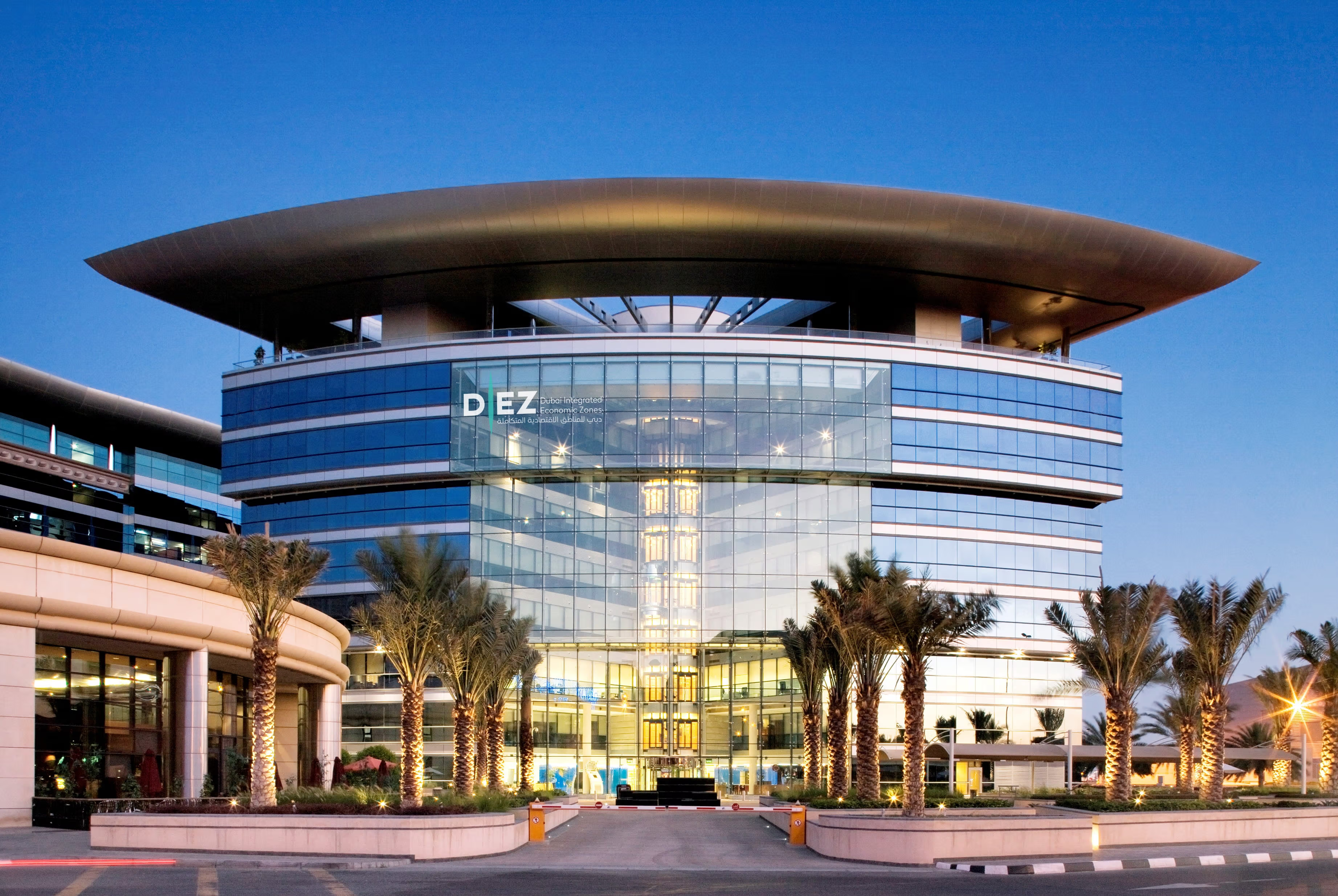
Dubai Integrated Economic Zones Authority recorded its strongest annual trade performance in 2025, with total trade reaching approximately $133.7 billion (AED 491 billion), a 46 percent increase from the previous year.
The result marked DIEZ’s fifth consecutive year of growth and lifted the authority’s contribution to Dubai’s non-oil trade to 16 percent. The performance came as Dubai’s non-oil external trade surpassed $816.9 billion (AED 3 trillion), reinforcing the emirate’s position as a regional and global trading hub.
DIEZ said its total trade value has quadrupled since 2020, with imports remaining the main driver of growth for the third year in a row. The authority also reported a sharp rise in physical trade activity, with total trade volume increasing 50 percent to 667,800 tons in 2025.
That volume growth is significant because it points to a broader expansion in goods movement rather than a rise driven only by higher prices or valuation effects. In practical terms, more cargo moved through DIEZ’s economic zones, suggesting stronger logistics activity, deeper supply-chain flows and higher commercial throughput across the authority’s ecosystem.
DIEZ Trade Growth Advances Dubai’s D33 Goals
The latest figures place DIEZ more firmly within Dubai’s wider economic strategy, particularly the Dubai Economic Agenda D33, which aims to double the size of Dubai’s economy by 2033 and increase the emirate’s foreign trade in goods and services to about $7 trillion (AED 25.6 trillion) over the decade.
Sheikh Hamdan bin Mohammed bin Rashid Al Maktoum, crown prince of Dubai, deputy prime minister, minister of defense and chairman of The Executive Council of Dubai, said:
“The exceptional growth is yet another example of Dubai’s ability to stay ahead of global shifts and turn them into new opportunities for growth. We congratulate the DIEZ team led by Sheikh Ahmed bin Saeed Al Maktoum on this achievement, which contributes to the goals of the Dubai Economic Agenda D33 and reinforces Dubai’s role as a city that connects markets, opportunities and investment from around the world. These results further show the continued trust that businesses, investors and trading partners place in Dubai’s economic foundations, world-class infrastructure and institutions. They also highlight the important role that Dubai’s economic zones play in enabling both regional and international trade and generating long-term economic value.”
The performance also highlights the role of specialized economic zones in Dubai’s long-term development model. Rather than relying only on headline trade values, the emirate has built a network of free zones, logistics corridors and sector-focused business districts designed to support international companies, re-export activity and regional supply chains.
Technology Goods Anchor DIEZ Trade Growth
DIEZ’s trade profile remained concentrated in two major categories. Machinery, electrical equipment and electronics accounted for more than 70 percent of total trade and grew 42 percent during the year. Precious stones, precious metals and pearls followed, rising 71 percent and contributing about 26 percent of total trade.
Together, the two categories represented roughly 96 percent of DIEZ’s total trade in 2025.
The dominance of machinery, electrical equipment and electronics reflects Dubai’s growing role as a platform for high-value goods moving between Asia, the Middle East, Africa and other international markets. These product categories are closely tied to technology supply chains, advanced manufacturing, consumer electronics, industrial equipment and digital infrastructure.
The sharp rise in precious stones and metals trade also shows that Dubai’s long-established position in gold, diamonds and related commodities continues to feed into its broader non-oil trade performance.
Trade Partners Reflect Dubai’s Global Reach
China remained DIEZ’s largest trading partner in 2025, accounting for 28.7 percent of total trade. Saudi Arabia ranked second at 9.6 percent, followed by India at 8 percent.
The partner mix reflects Dubai’s position between major Asian manufacturing centers, Gulf consumer and investment markets, and South Asian trade corridors. China’s leading position points to the continued importance of Asian supply chains, while Saudi Arabia’s role highlights strengthening regional trade links within the Gulf.
His Excellency Dr. Mohammed Al Zarooni, executive chairman of DIEZ, said: “The 2025 results confirm that DIEZ’s growth reflects genuine expansion in trade flows and cargo movement, rather than temporary price-driven factors. The rise in trade volume to 667,800 tons, alongside the expansion of high-value technology sectors, reflects the success of our strategy in diversifying partners, boosting re-exports, and developing supply chains. The evolving partner landscape, particularly the acceleration in trade with Saudi Arabia, creates new opportunities for deeper and more sustainable regional integration.”
DIEZ Becomes a Bigger Trade Driver
Established in 2021, DIEZ brings together Dubai Airport Free Zone, Dubai Silicon Oasis and Dubai CommerCity. The authority’s mandate is to consolidate and develop Dubai’s integrated economic zone model across aviation-linked trade, technology, innovation, e-commerce and digital business activity.
That structure gives DIEZ exposure to several of Dubai’s most important growth channels: global goods movement, technology-related commerce, digital trade and re-export flows. The 2025 result suggests those channels are becoming more central to Dubai’s non-oil trade base.
Sheikh Ahmed bin Saeed Al Maktoum, chairman of DIEZ, said the results demonstrated the resilience of Dubai’s economic model and its focus on “value-added activities, logistical integration, and technological advancement.”
National Trade Momentum Supports the Trend
DIEZ’s record performance also fits into a broader national trend. Official UAE figures show the country’s non-oil foreign trade reached a record $816.9 billion (AED 3 trillion) in 2024, supported by economic diversification, logistics investment and the continued expansion of the UAE’s Comprehensive Economic Partnership Agreement network.
Dubai’s role in that wider shift is especially important because the emirate functions as one of the UAE’s main gateways for trade, logistics, aviation, ports, re-exports and business services. Rising trade volumes make economic zones such as those under DIEZ increasingly important in connecting global companies with regional demand.
The 2025 figures show that DIEZ is no longer just a supporting part of Dubai’s trade infrastructure. With $133.7 billion (AED 491 billion) in total trade and a 16 percent share of the emirate’s non-oil trade, the authority has become one of the city’s major trade engines.