Nasdaq Dubai has added a $300 million Additional Tier 1 (AT1) Perpetual Sukuk issued by Ajman Bank to its securities list. This is the bank’s first capital securities transaction on the exchange. The listing follows the Sukuk’s pricing earlier in July 2026.
The $300 million instrument is a Perpetual Non-Call 5.5-year Sukuk structured under a Mudaraba arrangement with a profit rate of 6.50 percent. It allows Ajman Bank to strengthen its regulatory capital base and broaden its funding sources beyond traditional deposits. Following the listing, the bank now has a total of $800 million in Sukuk listed on Nasdaq Dubai.
The Sukuk was issued by Ajman Tier 1 Sukuk Ltd., a special purpose vehicle. It will be admitted to trading on Nasdaq Dubai as well as the London Stock Exchange’s International Securities Market.
Ajman Bank’s Capital Management
Ajman Bank is the first Islamic bank headquartered in the Emirate of Ajman. As of the end of the first quarter of 2026, the bank reported total assets of approximately $8.9 billion (AED 32.8 billion). Customer financing stood at about $6.3 billion (AED 23.2 billion), up 9 percent from the previous year.
This AT1 Sukuk follows the bank’s debut $500 million senior Sukuk issuance in 2025. The new transaction forms part of the bank’s ongoing efforts to manage its capital structure in line with regulatory requirements. Fitch Ratings has assigned the bank a BBB+ rating with a stable outlook.
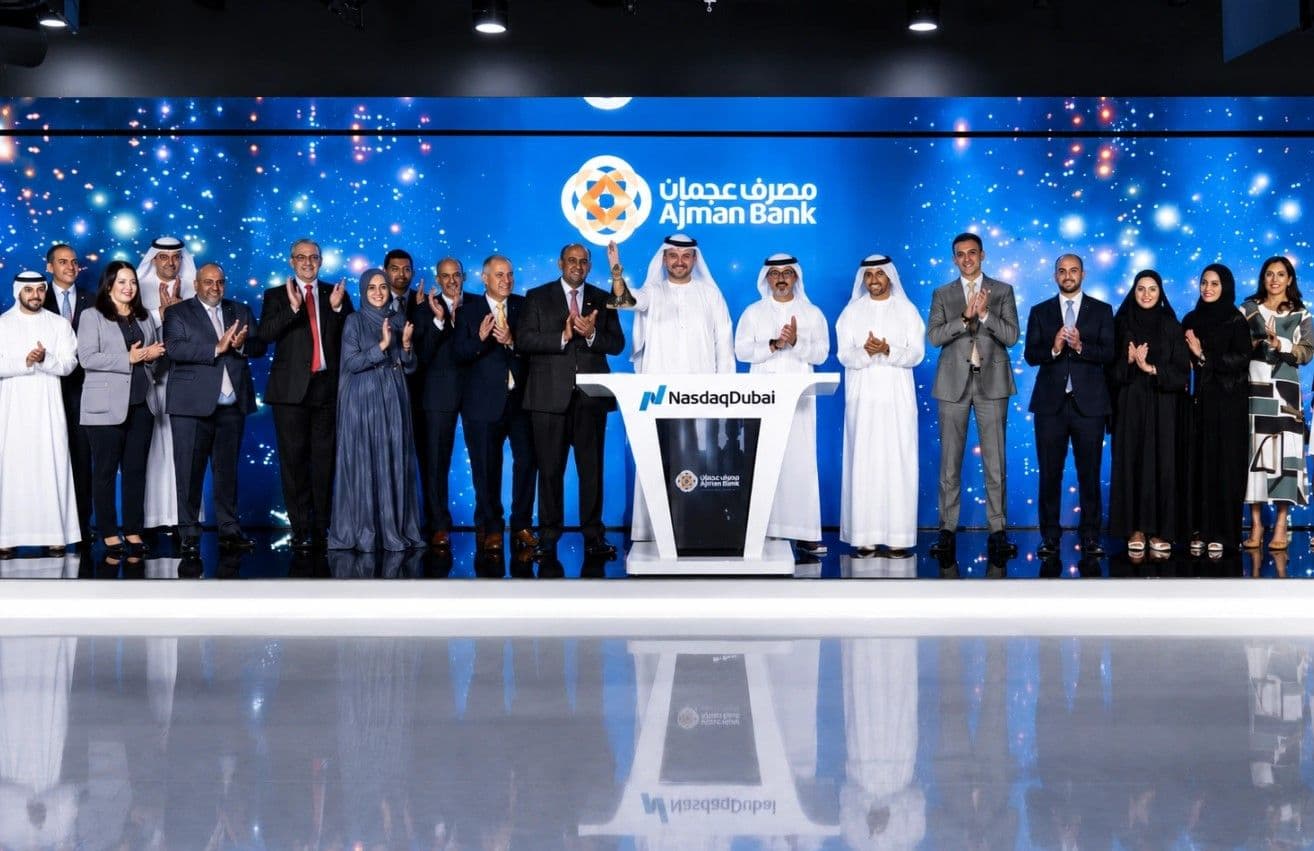
Mustafa Al Khalfawi, Chief Executive Officer of Ajman Bank, participated in a market-opening bell ceremony at Nasdaq Dubai to mark the listing. He was joined by Hamed Ali, Chief Executive Officer of Nasdaq Dubai and Dubai Financial Market.
Sukuk Issuance Details
The Sukuk attracted an order book that exceeded $500 million, excluding interest from joint lead managers. This level of demand represented approximately 1.7 times oversubscription. Geographically, 89 percent of the allocation went to investors in the MENA region, while 11 percent was distributed to investors in the UK, Europe, and Asia.
The instrument is designed as Additional Tier 1 capital, meaning it can be written down or converted into equity if the bank’s capital levels fall below certain thresholds. Such structures are commonly used by banks to meet Basel III-style capital rules in a Sharia-compliant manner.
Pricing was set at 6.50 percent after initial indications in the 7 percent area. The final terms reflect market conditions at the time of issuance and the bank’s credit profile.
Nasdaq Dubai’s Fixed Income Activity
Nasdaq Dubai currently has roughly $98 billion in outstanding Sukuk and more than $140 billion in total debt securities across 174 listings. The exchange functions as an international platform for issuers seeking access to regional and global investors.
Hamed Ali noted that Sukuk continue to play a role in helping financial institutions meet their capital requirements. The exchange provides a venue for both Sukuk and conventional bonds.
This latest listing adds to the volume of Islamic finance instruments available on the platform. Nasdaq Dubai operates under the regulatory oversight of the Dubai Financial Services Authority (DFSA).
UAE Banks and Capital Markets
Several banks in the United Arab Emirates have issued AT1 Sukuk in recent years as part of their capital management strategies. These instruments allow banks to raise capital that meets regulatory standards while adhering to Islamic finance principles.
The UAE banking sector has seen steady growth in the use of Sukuk for both senior funding and capital instruments. This activity forms part of the country’s broader development of its debt capital markets.
Ajman Bank’s issuance is one example of how mid-sized Islamic banks are accessing international markets. The bank’s previous senior Sukuk was listed on both Nasdaq Dubai and the London Stock Exchange.
Sukuk Market Landscape
The global Sukuk market has expanded significantly over the past decade, with the Gulf region remaining a major center of activity. Investors use these instruments to gain exposure to Sharia-compliant assets across various sectors, including banking, infrastructure, and real estate.
In the UAE, the development of fixed-income markets supports economic diversification goals. Debt issuances provide an additional channel for funding alongside equity markets and bank lending.
The listing of Ajman Bank’s AT1 Sukuk occurs amid regular activity on Nasdaq Dubai, where both local and international issuers bring new instruments to market throughout the year.