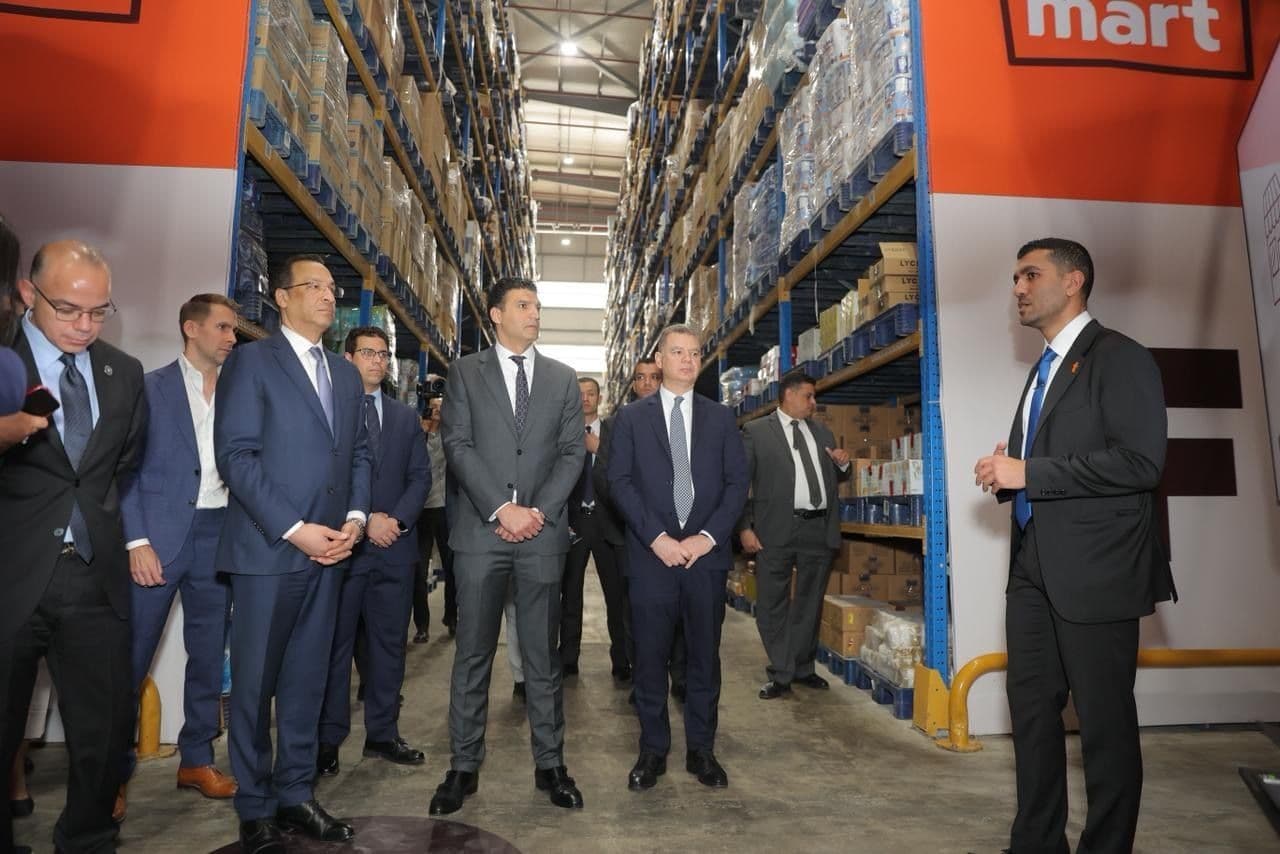
Talabat Egypt has inaugurated what it describes as the largest quick commerce distribution center in the Middle East and North Africa, a development that signals how aggressively delivery platforms are scaling logistics infrastructure across the region as demand for rapid grocery and retail fulfillment continues to rise.
The facility, located inside the YANMU East Logistics Park along the Cairo-Suez Road, spans roughly 27,000 square meters and is designed to support Talabat Mart operations across Egypt through AI-powered inventory management and fulfillment systems. The center currently serves 12 cities and is expected to expand coverage to 17 cities in the near future.
Talabat stated that the hub can process up to one million items per day, highlighting the scale of investment flowing into Egypt’s growing quick commerce sector.
The inauguration took place under the patronage of Egyptian Prime Minister Mostafa Madbouly and included officials from Egypt’s communications and investment sectors, reflecting the government’s broader push to strengthen digital infrastructure and attract technology-driven logistics investments.
Quick Commerce Drives Logistics Expansion
Quick commerce, commonly referred to as q-commerce, has become one of the fastest-growing segments within online retail. Unlike traditional e-commerce models that may deliver within days, q-commerce platforms rely on dense logistics networks and localized fulfillment systems to deliver groceries and daily essentials within minutes or hours. Companies operating in the sector increasingly depend on automation, forecasting software, and strategically placed fulfillment hubs to reduce delivery times while managing operating costs.
Talabat said the Egypt facility uses AI-driven systems to improve demand forecasting, replenishment cycles, and inventory allocation across its network. The company also noted that the center was designed with scalability in mind, allowing throughput capacity to increase without requiring a proportional expansion in physical space.
Egypt Pushes Deeper Into Digital Infrastructure
The launch reflects how digital commerce infrastructure in Egypt is becoming increasingly tied to broader economic policy. Officials attending the opening described the facility as part of the country’s ambition to position itself as a regional hub for logistics, technology services, and digital commerce.
The center is also expected to contribute to local employment and supply chain activity. Talabat said hundreds of jobs have already been created through the project, with additional hiring expected before the end of the year. The company added that the facility would support local suppliers and strengthen product distribution networks across multiple governorates.
The expansion comes as competition intensifies in Egypt’s online grocery and rapid delivery market. Regional and local players have continued investing in fulfillment infrastructure as consumer demand for app-based retail services grows across urban centers.
Egypt-based grocery delivery platform Breadfast, for example, has expanded its vertically integrated fulfillment network in recent years while increasing its focus on rapid delivery and grocery logistics.
Talabat itself has steadily expanded beyond restaurant delivery into grocery, convenience retail, pharmacy products, and on-demand commerce across several MENA markets. The company operates under Delivery Hero, the Germany-based global delivery group, and has continued investing in grocery and logistics capabilities across the region.
Logistics infrastructure is becoming one of the defining competitive advantages in q-commerce. While early delivery platforms focused heavily on customer acquisition and app growth, companies are now investing more in warehouse automation, routing systems, and inventory optimization to improve margins in a sector known for high operating costs.
Research into quick commerce logistics has shown that fulfillment efficiency and warehouse placement are becoming critical factors in profitability as platforms attempt to balance ultra-fast delivery expectations with operational sustainability.
Talabat’s latest Egypt investment appears to reflect that broader shift. Instead of relying solely on smaller “dark stores” spread across dense urban areas, the company is leaning into a larger centralized logistics model supported by automation and AI-assisted forecasting systems.
The facility’s launch also highlights how MENA delivery platforms are evolving into broader infrastructure and commerce companies rather than purely food delivery applications. In recent years, regional operators have expanded into cloud kitchens, fintech services, grocery marketplaces, subscription models, and retail fulfillment in an effort to diversify revenue streams and increase customer retention.
Egypt, one of the region’s largest consumer markets, is likely to see continued investment in faster and more efficient delivery infrastructure as digital commerce adoption rises and expectations around delivery speed become increasingly normalized.
The economics of rapid delivery remain under pressure globally, pushing companies to focus more heavily on operational efficiency and automation. Large-scale fulfillment hubs like Talabat’s Cairo-area center may offer one path toward improving scale and lowering fulfillment costs while maintaining rapid delivery capabilities.