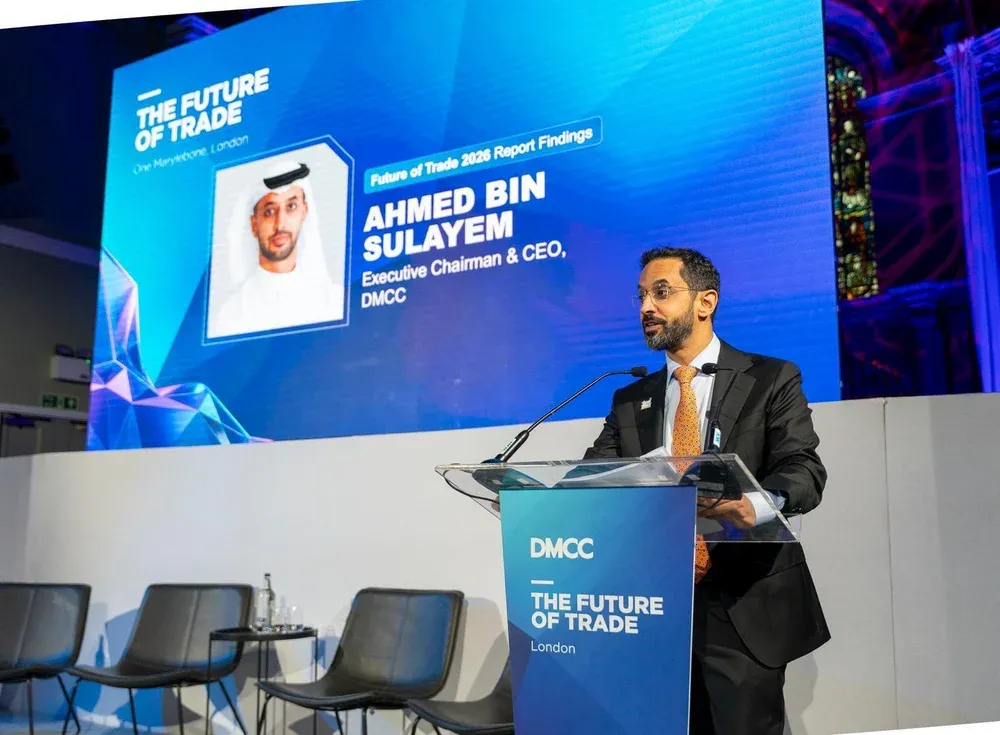
Global commerce is not simply passing through another temporary shock. It is being redesigned around artificial intelligence, tariff volatility, supply chain security and the race for critical minerals, according to a new report from Dubai Multi Commodities Centre.
The DMCC Future of Trade 2026 report, titled Rebuilding Through Rupture, argues that companies are moving into a trade environment where disruption is no longer an exception to plan around, but a condition to manage. More than 80 percent of business leaders surveyed for the report expect slow trade growth, continued supply chain disruption and prolonged geopolitical volatility in the coming years.
The findings come at a time when governments and companies are rethinking the assumptions that shaped globalization for decades. Low-cost sourcing, long supply chains and predictable tariff frameworks are giving way to a more guarded model, where resilience, technology access and strategic materials increasingly influence trade decisions.
AI Reshapes What the World Trades
One of the report’s most striking findings is the speed at which AI-linked goods are moving through global trade channels. DMCC said AI-related goods, including semiconductors, servers and data center hardware, represented 15 percent of global trade by volume but accounted for 43 percent of merchandise trade growth in the first half of 2025.
That shift helps explain why the AI boom is no longer just a technology-sector story. It is becoming a trade story, a logistics story and, increasingly, an infrastructure story. Advanced chips, high-performance servers, cooling systems, power equipment and data center components are now part of the physical backbone of digital growth.
The World Trade Organization has also linked stronger-than-expected merchandise trade performance in 2025 to demand for AI-related goods, alongside frontloading ahead of tariff increases. That context supports DMCC’s broader point: AI is not only changing how trade is managed through automation and compliance tools, but also what countries and companies are trading.
Yet the transition is uneven. Fewer than 15 percent of firms surveyed by DMCC described their AI deployment as fully integrated, while more than a quarter reported no meaningful adoption. That gap could harden into a competitive divide as AI becomes embedded in customs processing, documentation, logistics routing, risk assessment and trade finance.
Tariff Risk Forces Businesses to Rethink Plans
The return of tariff risk is another central theme in the report. DMCC said nearly one fifth of global merchandise imports are now affected by tariffs or similar measures, up from 12.6 percent a year earlier. The organization expects this uncertainty to weigh on trade growth, forecasting merchandise exports to slow to 1.9 percent in 2026 after growing 4.6 percent in 2025, before a partial recovery to 2.6 percent in 2027.
The practical concern is not only the tariff rate itself, but the loss of predictability. A supplier relationship that makes commercial sense today can quickly become less competitive if new duties, sanctions or compliance rules are introduced with little warning.
The OECD reported that U.S. import growth in the first quarter of 2025 was partly driven by companies accelerating shipments ahead of expected tariff costs. That kind of frontloading can support trade numbers temporarily, but it also signals anxiety among importers about future policy conditions.
DMCC’s message is that businesses are increasingly planning for a less stable tariff environment. Rather than treating trade policy as background noise, companies are being pushed to model tariff exposure, test alternative sourcing routes and build flexibility into contracts and inventories.
Resilience Becomes the New Supply Chain Priority
The report also captures a wider move away from the classic “just-in-time” model. Efficiency remains important, but it is no longer the only measure of a strong supply chain. Businesses now want backup routes, diversified suppliers and better visibility into the weak points that could disrupt production.
DMCC said 45 percent of businesses surveyed had already engaged in onshoring, nearshoring or friendshoring. The report also points to the rise of “China plus many” strategies, where companies look beyond a single alternative market and instead spread production or sourcing across several locations.
This does not mean globalization is ending. A more accurate reading is that globalization is becoming more selective. Trade is still expanding across many corridors, but companies are placing greater value on reliability, political alignment, energy access and logistics optionality.
That trend is particularly relevant for Dubai and the wider Gulf. Trade hubs that can connect multiple regions, offer business infrastructure and provide access to commodities, finance and logistics may gain importance as companies seek neutral or flexible operating bases.
Critical Minerals Move to the Center of Trade Strategy
The energy transition has added another layer of pressure to global trade. Minerals used in electric vehicles, wind turbines, batteries, defense systems, semiconductors and data centers are increasingly treated as strategic assets rather than ordinary inputs.
DMCC’s report highlights the concentration risk around critical minerals and clean technology supply chains. The International Energy Agency has warned that critical minerals have become a major focus in global policy and trade discussions because of price volatility, supply chain bottlenecks and geopolitical concerns. In a separate IEA commentary, the agency noted that China is the leading refiner for 19 of 20 important strategic minerals and accounts for 94 percent of global production of sintered permanent magnets, which are used in vehicles, wind turbines, industrial motors, data centers and defense systems.
This concentration creates a difficult problem for governments and companies. New mines, processing facilities and recycling capacity take years to develop, while demand from electrification, AI infrastructure and advanced manufacturing is rising now. As a result, critical minerals are becoming one of the clearest examples of how industrial policy, trade policy and national security are merging.
Trade Finance Faces a Technology Reset
Trade finance is another pressure point. DMCC cited a global trade finance gap of $2.5 trillion, with small and medium-sized businesses and developing-economy exporters facing the biggest constraints.
The report suggests that digital settlement tools, tokenization, stablecoins and wholesale central bank digital currencies could help improve speed and flexibility in some corridors. That does not mean traditional banks are being replaced. More likely, trade finance will become a hybrid system in which conventional banking rails operate alongside regulated digital payment and settlement tools.
The challenge is practical: exporters and importers need faster access to liquidity, smoother cross-border settlement and less friction in documentation-heavy transactions.
South-South Corridors Gain Momentum
Another important finding is the growing role of South-South trade. DMCC said trade between developing economies now accounts for about 35 percent of global trade and is outpacing North-North flows.
That shift gives more influence to middle-power economies and trade connectors such as the UAE, India and Singapore. These markets are not simply participating in global trade; they are helping reroute it. Companies diversifying supply chains and searching for new growth corridors may give well-connected trade hubs a greater chance to capture investment, logistics activity and financial flows.
The main conclusion from DMCC’s report is not that global trade is collapsing. It is that the old version of stability is fading. Commerce is still moving, but the rules, routes and technologies behind it are changing quickly.